
PDPA Checklist for Appointment-Based Businesses in Singapore
A plain-English PDPA checklist for Singapore clinics, studios, tuition centres and salons that take bookings and hold customer data, with a practical table.
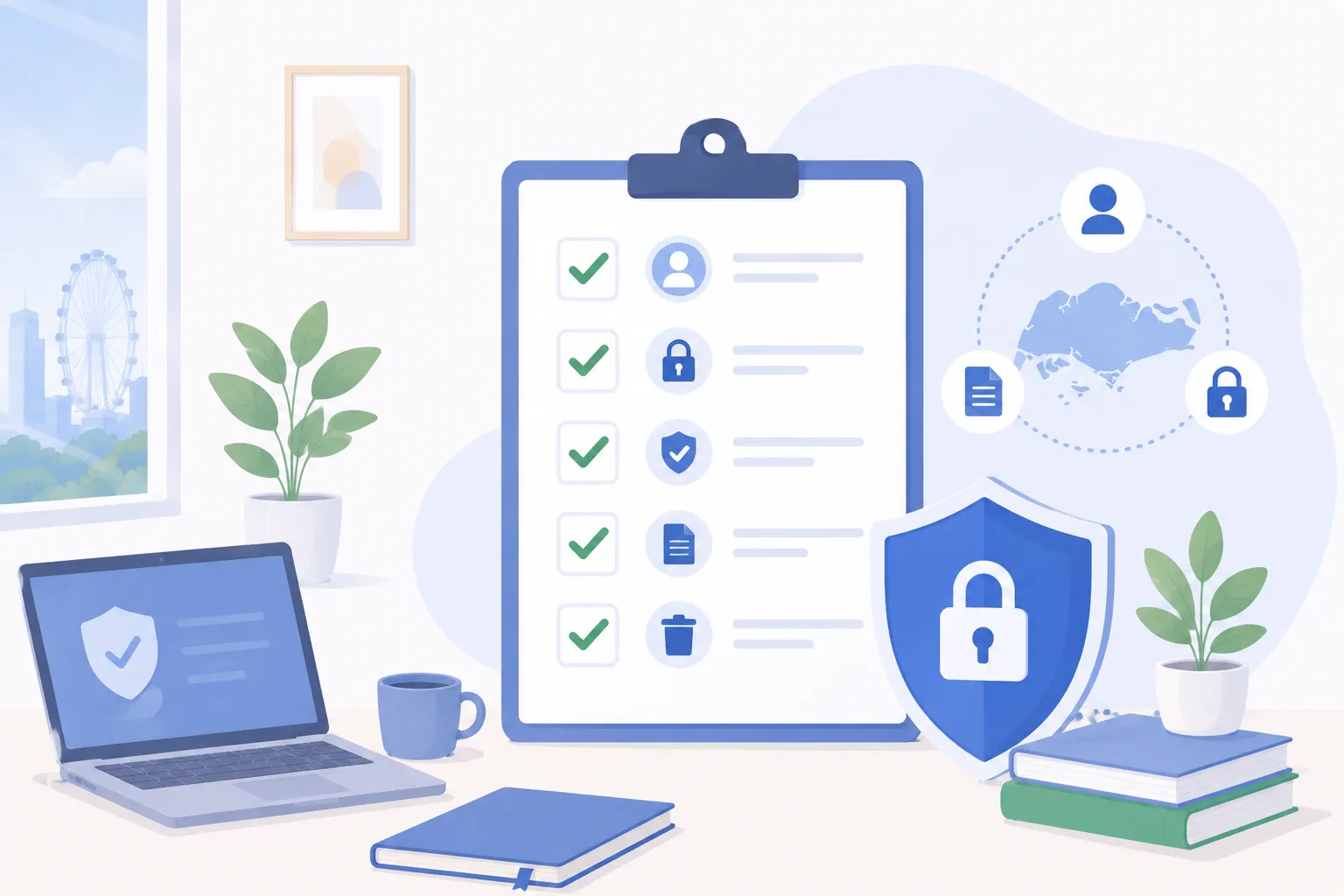
A practical PDPA checklist for Singapore businesses that take bookings — clinics, studios, tuition centres, and salons (2026).
TL;DR
If your business takes appointments, you are holding personal data: names, phone numbers, payment details, and often health or family information. The Personal Data Protection Act (PDPA), overseen by the Personal Data Protection Commission (PDPC), sets out how that data should be handled. The core ideas are common-sense: get consent, collect only what you need, tell people why, keep it reasonably secure, do not keep it forever, let people see and correct it, deal honestly with breaches, and stay accountable even when a software vendor does the processing. This article turns those principles into a checklist you can act on, with a table you can keep beside you.
This is general guidance to help you organise your thinking. It is not legal advice. For a definitive view, refer to the PDPC’s published guidance or speak to a qualified professional.
Why this matters for a booking business specifically
Most data-protection advice is written for large companies with a compliance team. A clinic, a Pilates studio, a tuition centre, or a salon usually has none of that — just a front desk, a phone, a few spreadsheets, and a booking tool. Yet these businesses often hold more sensitive data than a typical retailer: a physiotherapist knows about injuries, a tuition centre knows children’s names and parents’ numbers, a clinic holds medical history.
The risk is rarely a dramatic hack. It is mundane: a shared WhatsApp group where anyone can scroll back through patient details, a spreadsheet of phone numbers emailed to a freelancer, a part-timer who can see everyone’s payment information. The PDPA is not asking you to be perfect. It is asking you to be reasonable and deliberate about data you are already responsible for. A modern online booking system does a lot of this quietly for you, but you still need to understand the obligations.
The eight things to get right
1. Consent at the point of booking
Get the customer’s agreement to collect and use their data, for a purpose you have actually told them. Consent should be a clear, voluntary action — not a pre-ticked box and not buried in a wall of terms. At booking, a short line such as “We collect your details to manage your appointment and send reminders” plus the customer choosing to proceed is far stronger than silence.
Why it matters: consent is the foundation. If you cannot show why you were entitled to hold someone’s data, every later step is on shaky ground.
2. Collect only what you need (minimisation and purpose limitation)
Ask yourself, for each field on your booking form: do I genuinely need this to deliver the service? A salon does not need a customer’s NRIC. A tuition centre booking a trial class probably does not need full medical history. Collect data for a specific purpose, and do not quietly reuse it for something else later.
Why it matters: data you never collected cannot leak, be misused, or become a liability. Less is safer and simpler.
3. Tell customers why (notification)
People should know what you are collecting and the purpose, in plain language, at or before the point you collect it. This is the partner to consent: you cannot meaningfully consent to something you were never told.
Why it matters: it builds trust and removes the “I never agreed to that” dispute. A one-paragraph notice on your booking page usually does the job.
4. Reasonable security — and who can see what
Protect personal data with security that is reasonable for its sensitivity. For a booking business the most overlooked control is access: who on your team can see contact details, appointment notes, and especially payment information? A receptionist may need to see names and times but not card details. A part-time instructor may need today’s class list but not the full client database.
Why it matters: most real-world incidents are internal and accidental, not external attacks. Separating who sees payment data from who sees contact data shrinks the blast radius if anything goes wrong. This is exactly where role-based access in your booking tool earns its place.
5. Retention limits — do not keep it forever
Set how long you keep each type of record, and delete or anonymise it once there is no longer a business or legal reason to hold it. A lead who never booked does not need to sit in your system for years. Note that some records — certain health or financial documents — have their own retention rules, so “delete everything quickly” is not always right either.
Why it matters: old data you have forgotten about is pure downside. It cannot earn you anything, but it can still leak.
6. Honour access and correction requests
Be ready for a customer to ask what data you hold about them and how it has been used, and to ask you to fix errors. You do not need a fancy portal, but you do need to be able to find a person’s records quickly and correct them reliably.
Why it matters: these requests are a right, not a favour. Handling one calmly and promptly is a small effort that signals you take data seriously — and structured records make it painless.
7. Be ready for a data breach
If personal data is compromised in a way that could cause harm, the PDPA expects you to assess it and, where it meets the threshold, notify the PDPC and affected individuals. The practical readiness step is to decide in advance who is responsible, how you would assess what happened, and how you would contact affected customers.
Why it matters: breaches are stressful and time-pressured. A simple plan written today beats improvising on a bad day. (We are deliberately not quoting timelines or figures here — check the PDPC’s current guidance for the specifics.)
8. Stay accountable when you use a software vendor
When a booking platform or other software processes data on your behalf, it acts as a data intermediary. That is normal and fine — but accountability still sits with you. Choose vendors with reasonable security, understand where data is stored and who can access it, and keep the arrangement documented.
Why it matters: you cannot outsource responsibility. If you would not let a stranger walk through your filing cabinet, apply the same standard to the systems you sign up for.
The checklist, in one table
| # | Principle | What to do | Why it matters |
|---|---|---|---|
| 1 | Consent | Get a clear, voluntary yes at booking for a stated purpose | It is the legal basis for everything you hold |
| 2 | Minimisation & purpose limitation | Collect only the fields you genuinely need | Data you never collect cannot be misused |
| 3 | Notification | Tell customers what and why, in plain language | Consent is meaningless without it; builds trust |
| 4 | Reasonable security & access control | Limit who sees contact vs payment vs notes | Most incidents are internal and accidental |
| 5 | Retention limits | Set a period per data type; delete or anonymise on schedule | Old data is liability with no upside |
| 6 | Access & correction | Be able to retrieve and fix a person’s records | It is the individual’s right, not a favour |
| 7 | Breach readiness | Decide in advance who assesses and notifies | Calm beats improvising under pressure |
| 8 | Accountability with vendors | Vet your data intermediary; document the arrangement | Responsibility stays with you |
A realistic example
A typical tuition centre might collect, for every trial booking: child’s name, parent’s name and mobile, the subject, and a free-text note. Under this checklist, the centre would show a one-line purpose statement at booking (notification + consent), drop any field it does not actually use such as the child’s full address (minimisation), make sure relief tutors see only their class roster and not parents’ payment history (access control), and set a rule that trial leads who never enrol are cleared after a set period (retention). None of that requires a compliance department — it requires a system that defaults to the safe choice and a short policy the front desk can follow.
Healthcare practices carry the highest sensitivity and are worth treating with extra care; if that is you, our healthcare booking page goes deeper on patient scheduling and intake, and the companion guide on a clinic appointment booking system in Singapore covers how to move records off ad-hoc WhatsApp threads into something defensible.
Where software helps — and where it doesn’t
A good booking platform handles several of these obligations as a side effect of being well built: consent captured at the moment of booking, data stored in one structured place you can search and export, records you can retrieve or correct in seconds, and role-based permissions so staff see only what their job requires. That removes the most common sources of accidental exposure.
What software cannot do is decide your purposes for you, write your retention policy, or judge a breach. Those are business decisions. Treat the tool as the part that enforces good habits, and keep the thinking — what you collect and why — as your own.
BooknGo records are built to be PDPA-aligned: consent is captured at booking, data sits in structured records rather than scattered chats and spreadsheets, and role-based access means a receptionist, an instructor, and an owner each see only what they should. That is a genuine help with the security, access, and accountability parts of this checklist — but it is a help, not legal advice, and it does not replace the PDPC’s guidance.
See how BooknGo captures consent at booking and uses role-based access to keep customer and patient data PDPA-aligned. Request a demo →
Frequently asked questions
Does the PDPA apply to a small clinic, studio, or tuition centre?
Yes. The PDPA applies to organisations of any size that collect, use, or disclose personal data in Singapore. A solo practitioner holding a list of client names, phone numbers, and appointment notes is handling personal data, so the obligations apply just as they do to a large chain. Being small does not exempt you.
What counts as valid consent at the point of booking?
Consent should be a clear, voluntary action by the customer for a purpose you have actually told them about. A pre-ticked box or burying the purpose in dense terms is weak. The cleaner approach is a short, plain statement of why you collect the data, shown at the moment of booking, with the customer choosing to proceed. Keep a record of when and how consent was given.
How long can I keep customer or patient records under the PDPA?
The PDPA expects you to stop retaining personal data once it no longer serves the purpose it was collected for, and once there is no legal or business need to keep it. There is no single universal period — some records (such as certain health or financial documents) have their own retention rules. The practical step is to set a retention period per data type and delete or anonymise on schedule.
What do I have to do if a customer asks to see or correct their data?
Under the PDPA's access and correction principles, an individual can ask what personal data you hold about them and how it has been used, and can ask you to correct errors. You should have a simple way to retrieve a person's records and a process to make corrections. Plan for these requests rather than scrambling when one arrives.
Am I still responsible if my booking software vendor handles the data?
Yes. When a vendor processes personal data on your behalf, they act as a data intermediary, but accountability for the data still sits with you as the organisation. You should choose vendors with reasonable security, understand where data is stored and who can access it, and keep that relationship documented. Outsourcing the processing does not outsource the responsibility.
Is BooknGo a substitute for legal advice on PDPA compliance?
No. BooknGo is built to support good data practice — consent capture at booking, role-based access so staff see only what they need, and structured records you can retrieve and correct — but it is a tool, not legal advice. For a definitive view of your obligations, consult the PDPC's guidance or a qualified professional.
Related articles
Moving Your Bookings Online in Singapore: A Step-by-Step Guide for Service Businesses
A practical, vendor-neutral walkthrough for Singapore clinics, studios and tuition centres moving from phone and WhatsApp bookings to online self-service.
Online Booking vs Phone & DM Bookings: The Real Cost (Singapore)
An honest cost comparison of taking bookings by phone, WhatsApp and walk-in versus a 24/7 online booking page for Singapore service businesses.
The State of Online Booking in Singapore 2026
How Singapore consumers and service businesses book in 2026 — self-service, mobile-first, PayNow at booking, WhatsApp reminders, and owning your own page.
Ready to fill every slot?
See how BooknGo keeps your calendar full and your admin on autopilot.