
Online Booking vs Phone & DM Bookings: The Real Cost (Singapore)
An honest cost comparison of taking bookings by phone, WhatsApp and walk-in versus a 24/7 online booking page for Singapore service businesses.
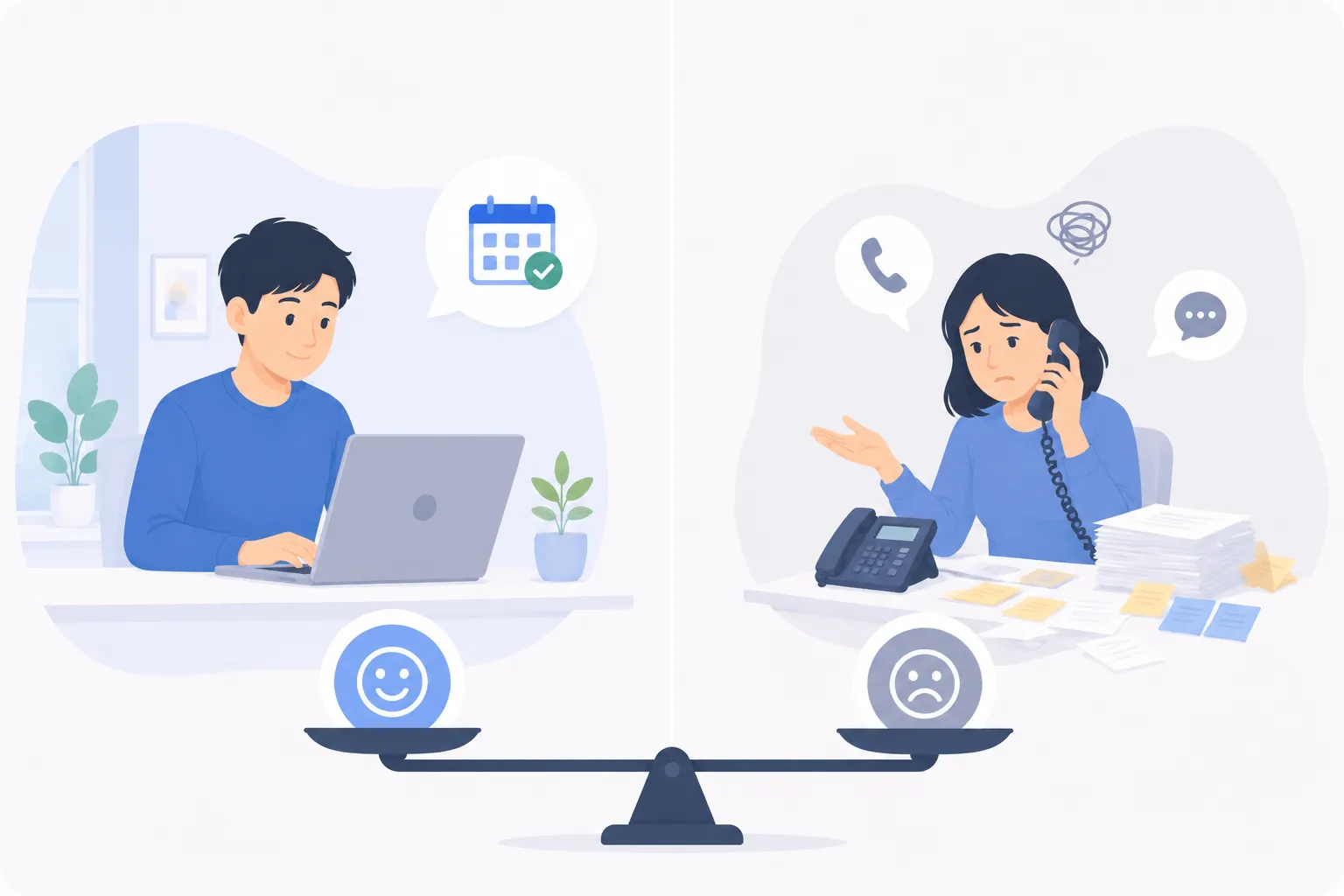
An honest comparison for Singapore service businesses — salons, clinics, studios, tutors, and trades.
TL;DR
Taking bookings by phone, WhatsApp DM, and walk-in feels free because there is no software invoice. But it carries hidden costs: calls missed during sessions, after-hours enquiries that go to a competitor, endless back-and-forth on chat, double-bookings, no-shows, admin hours, and no clean record trail. A self-service online booking page captures bookings 24/7, confirms instantly, takes a deposit or PayNow payment up front, and sends automated reminders — which cuts no-shows and admin load. This is not an argument to delete your phone. The right setup keeps the human touch where it matters and automates the routine bookings that do not need a person.
The “free” booking method that quietly costs the most
Most Singapore service businesses started the same way: clients call, message on WhatsApp, or walk in. It works. It feels personal. And it appears to cost nothing because there is no subscription line on your bank statement.
The cost is real, it is just invisible. It hides inside your day. It is the call you could not pick up because you were mid-session with a client. It is the 10pm WhatsApp enquiry you saw the next morning, after the person had already booked elsewhere. It is the 12 messages it took to settle on one appointment time. It is the slot you accidentally double-booked, and the awkward call to un-book it.
None of these show up as a number you can point to. That is exactly why they persist.
Where manual bookings leak money and time
Let us be specific about the failure points, because “it works fine” usually means “it works fine until it is busy” — and busy is when bookings matter most.
Missed calls during sessions
If you are a solo therapist, a tutor mid-lesson, or a stylist with a client in the chair, you cannot answer the phone. The caller rarely leaves a voicemail. They call the next place. You never knew the booking existed, so you cannot even count what you lost.
After-hours enquiries that evaporate
A large share of booking intent in Singapore happens outside business hours — evenings, lunch breaks, late at night. A phone line and a manned WhatsApp inbox are both closed at 11pm. The enquiry either waits until morning, by which time the person may have booked elsewhere, or it disappears entirely.
The WhatsApp back-and-forth
WhatsApp is the default booking channel for many Singapore businesses, and for good reason — open rates here exceed 90%. But as a booking tool it creates work. “Are you free Saturday?” “Morning or afternoon?” “3pm?” “Can do 3.30?” Each booking becomes a thread. Multiply that across a day and a real chunk of staff time goes to coordination that software can do instantly.
Double-bookings and human error
When availability lives in your head, a paper book, or three separate chat threads, two clients eventually get the same slot. Someone has to be turned away or rescheduled. It is avoidable, and it costs goodwill every time.
No-shows
Manual booking has no built-in reminder and usually no deposit. The client who booked a week ago simply forgets. The slot sits empty, the time is gone, and you cannot recover it.
Admin time you are not billing for
Every manual booking is minutes of someone’s day — answering, checking the calendar, confirming, reminding, rescheduling. Those minutes are unpaid and they scale with your business, not against it.
No record trail
Walk-ins and DMs rarely leave a clean record. Who booked, when, what they paid, whether they consented to you keeping their details — it is scattered or missing. That is an operational headache and, under Singapore’s PDPA, a compliance risk, since you are expected to handle personal data with consent, a clear purpose, reasonable security, and sensible retention.
What an online booking page changes
A self-service online booking system does not make your business less personal. It removes the routine coordination so the personal parts get more of your attention.
Here is what shifts:
- 24/7 capture. The booking page is open when you are asleep, in a session, or off for the day. The 11pm enquiry becomes an 11pm booking, not a lost one.
- Instant confirmation. The client picks a real available slot and gets confirmation on the spot. No “let me check and get back to you.”
- Deposits and PayNow at booking. Collecting a deposit or full payment up front turns a soft “maybe” into a real commitment. With online payment at booking, PayNow and card are built into checkout, and each payment generates a GST-compliant receipt. PayNow processed 1.2 billion transactions in Singapore last year, up 48% year-on-year (MAS, 2025) — your clients already expect to pay this way.
- Automated reminders. Automated reminders over WhatsApp, SMS, or email go out before the appointment without anyone lifting a finger. Forgetting is the top cause of no-shows, and reminders attack it directly.
- Fewer no-shows. The combination of an upfront deposit and a timely reminder is the single most reliable way to bring missed appointments down.
- One clean record. Every booking, payment, and consent lands in the same system, captured with the client’s consent at the point of booking — far closer to what PDPA expects than scattered chat threads.
Side-by-side: the real cost of each approach
| Factor | Phone / WhatsApp DM / walk-in | Self-service online booking |
|---|---|---|
| Availability | Only when you can answer | 24/7, including nights and weekends |
| After-hours enquiries | Often lost to a competitor | Captured and confirmed automatically |
| Time to confirm a booking | Several messages or a call | Seconds, self-service |
| Staff admin time per booking | Minutes each, scales up | Near zero for routine bookings |
| Double-bookings | Common when busy | Prevented across all channels |
| Deposits / payment | Chased separately, often skipped | Collected at booking via PayNow or card |
| Reminders | Manual, easily forgotten | Automated before every appointment |
| No-show rate | Higher — no deposit, no reminder | Lower — deposit plus reminder |
| Record keeping | Scattered, hard to audit | One trail, consent captured, PDPA-aligned |
| Personal rapport | Strong | Reserved for enquiries that need it |
| Visible monthly cost | ”Free” | A subscription |
| Hidden cost | High and invisible | Low and predictable |
The honest summary: manual booking has no invoice but a high hidden cost. Online booking has a visible subscription and a low hidden cost. For most Singapore service businesses past the very smallest scale, the trade favours online.
Where the phone still wins — and how online complements it
This would not be an honest comparison if it claimed software beats a human at everything. It does not.
A phone call or a WhatsApp chat is better when:
- The enquiry is complex or unusual — a bespoke package, an accessibility need, an unusual request that does not fit your standard service list.
- The client is new and uncertain, and a quick conversation builds the trust that turns a browser into a booking.
- The client prefers a person — some clients, including many elderly clients, will always want to speak to someone, and pushing them online costs you their business.
- Something has gone wrong — a complaint, a rescheduled emergency, anything that needs empathy rather than a form.
The right model is not “online instead of phone.” It is “online for the routine, human for the rest.” Let the booking page absorb the simple “I just want a 3pm slot” bookings — the ones that are pure scheduling — so your team has more time and attention for the conversations that genuinely benefit from a person. Staff can still enter phone and walk-in bookings into the same calendar, so you keep one clean record regardless of how the booking came in.
If you run classes or sessions and want to see this hybrid model applied to a specific vertical, our guide to class booking software in Singapore walks through it in more detail.
A simple way to decide
You do not need to flip everything overnight. A practical test:
- For one week, tally how many enquiries arrive outside the hours you can answer. That is your after-hours leak.
- Note how many no-shows you had, and whether any reminder went out. That is your reminder gap.
- Estimate the minutes per booking your team spends coordinating. Multiply by your weekly booking count. That is your admin cost.
If those three numbers are small, manual booking is genuinely fine for you, and you should not over-engineer it. If any of them is uncomfortable, an online booking page will likely pay for itself — not in theory, but in recovered bookings and reclaimed hours.
The point of moving online is not to sound modern. It is to stop losing bookings you never see, and to give your time back to the work clients actually pay you for.
See exactly how a 24/7 booking page, PayNow deposits, and automated reminders would work for your business. Request a demo →
Frequently asked questions
Is online booking really cheaper than taking bookings by phone or WhatsApp?
Phone and WhatsApp bookings look free because there is no software bill, but they carry real costs: missed calls during sessions, enquiries lost after hours, staff time spent on back-and-forth, double-bookings, and no-shows from forgotten appointments. A self-service booking page captures those enquiries automatically and sends reminders, so the saved admin time and recovered bookings usually outweigh the subscription cost quickly.
Will an online booking page replace my phone and WhatsApp entirely?
No, and it should not. Phone and WhatsApp still matter for complex enquiries, first-time questions, elderly clients, and building rapport. The goal is to remove the routine, repetitive bookings — the ones that are just picking a time — from your channels, so your team has more capacity for the conversations that genuinely need a human.
How does online booking reduce no-shows for a Singapore business?
Two mechanisms do most of the work. First, automated WhatsApp, SMS, or email reminders sent before the appointment cut the most common cause of no-shows, which is simply forgetting. Second, taking a deposit or full payment at the time of booking — via PayNow or card — adds a financial commitment that makes clients far less likely to drop off without notice.
Can clients still pay by PayNow if I move to online booking?
Yes. A good Singapore booking system has PayNow built into the checkout, including QR generation, alongside card payment. Clients can pay a deposit or the full amount when they book, and each transaction generates a GST-compliant receipt automatically, so you are not chasing payment separately over chat.
Is it hard to set up an online booking page if I currently use WhatsApp?
No. Most small Singapore businesses can have a live booking page running in a day or two — set your services, durations, availability, and capacity, connect PayNow, and switch on reminders. You keep WhatsApp as a communication channel; you are only removing the manual coordination that currently sits behind it.
What about clients who prefer to call or message rather than book online?
Keep both open. Many businesses run a hybrid model where most routine bookings come in online while phone and WhatsApp handle the rest, and staff enter those manually into the same calendar. That gives every client their preferred channel while still giving you one clean record of every booking, with no double-bookings across channels.
Related articles
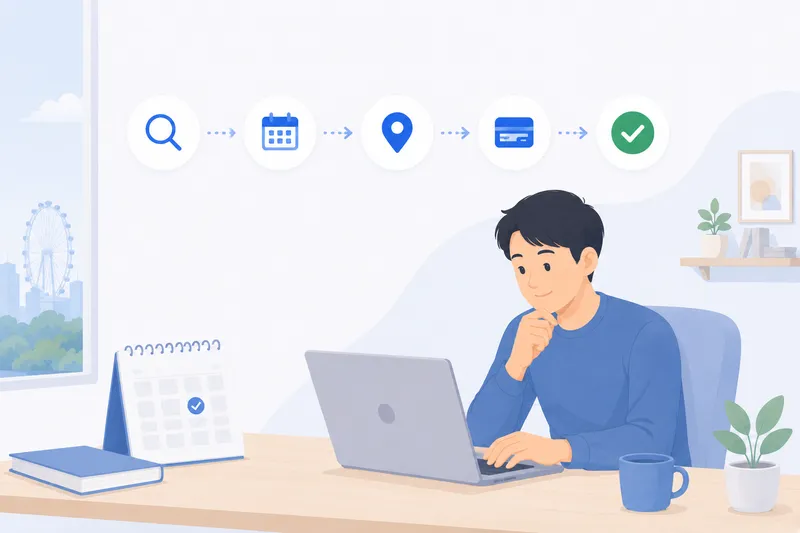
Moving Your Bookings Online in Singapore: A Step-by-Step Guide for Service Businesses
A practical, vendor-neutral walkthrough for Singapore clinics, studios and tuition centres moving from phone and WhatsApp bookings to online self-service.
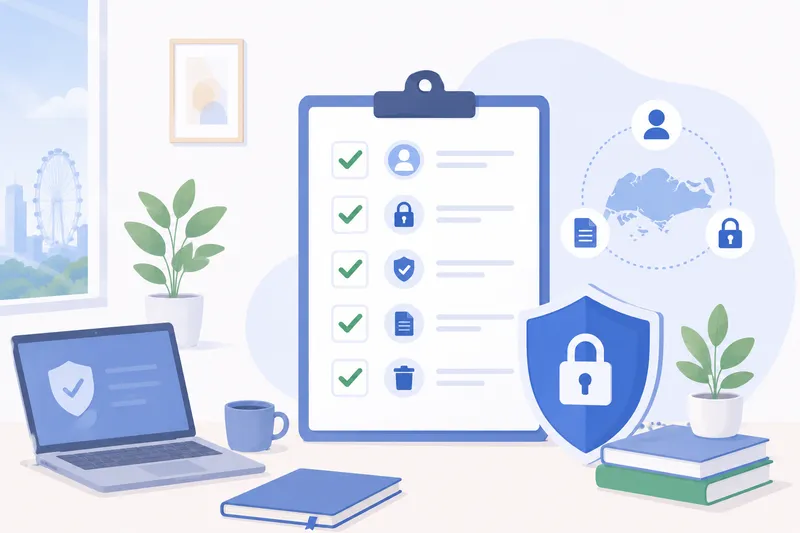
PDPA Checklist for Appointment-Based Businesses in Singapore
A plain-English PDPA checklist for Singapore clinics, studios, tuition centres and salons that take bookings and hold customer data, with a practical table.
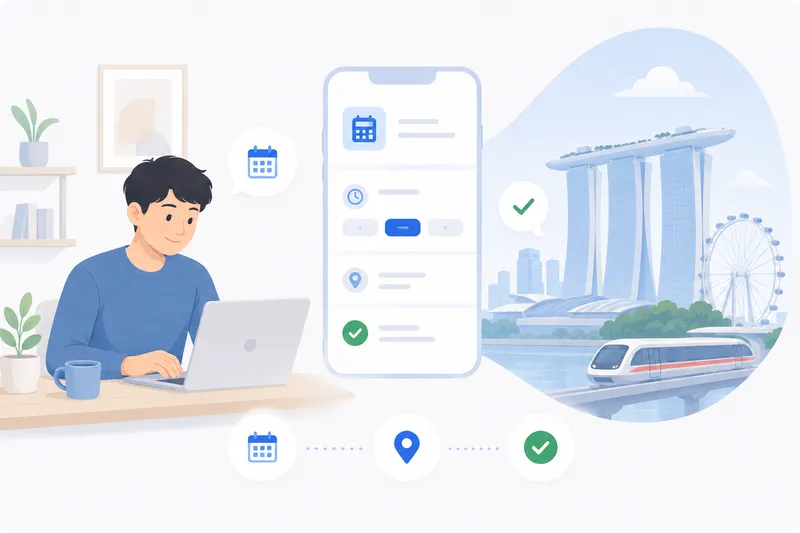
The State of Online Booking in Singapore 2026
How Singapore consumers and service businesses book in 2026 — self-service, mobile-first, PayNow at booking, WhatsApp reminders, and owning your own page.
Ready to fill every slot?
See how BooknGo keeps your calendar full and your admin on autopilot.