
Clinic Appointment Booking System Singapore
Singapore clinics lose revenue in predictable, fixable ways — patients who can't reach you book elsewhere, slots go empty without reminders, and WhatsApp-based records create PDPA exposure. Here's how the right booking system fixes all three.
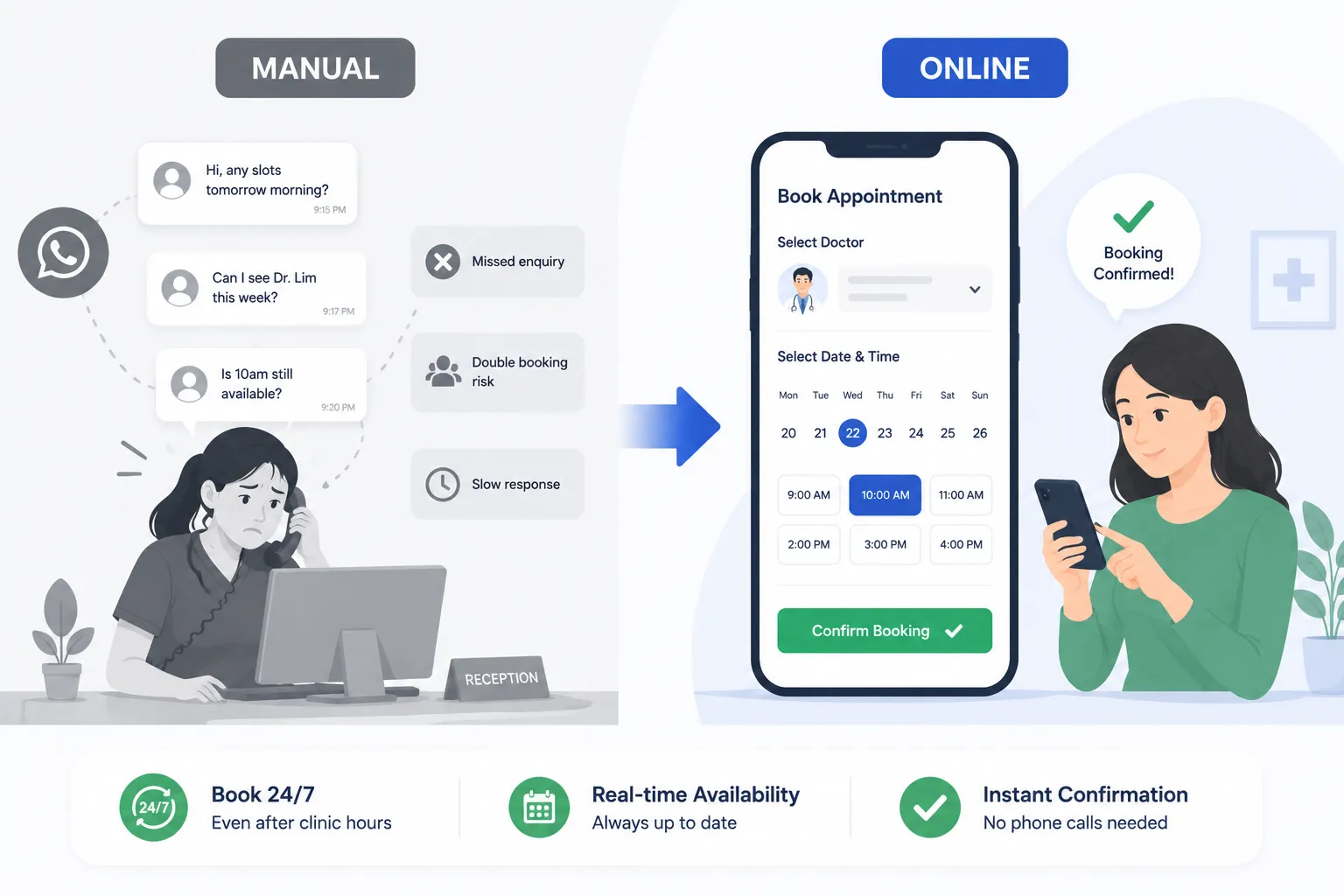
A practical guide for GP clinics, TCM practices, dental, physiotherapy, and specialist clinics (2026).
TL;DR
Singapore medical clinics and TCM practices lose revenue in ways that are predictable and fixable: patients who cannot reach you by phone book elsewhere, appointment slots go empty when no reminder was sent, and patient data collected through WhatsApp and spreadsheets creates real PDPA exposure. The right clinic appointment booking system solves all three — 24/7 online patient booking, automated WhatsApp and SMS reminders, and PDPA-compliant patient record management built in as standard.
BooknGo is built in Singapore for medical and allied health practices — with native PayNow, WhatsApp reminders, custom intake forms, multi-doctor scheduling, and PDPA compliance by design.
The problem is not the phone. It is WhatsApp.
Most Singapore clinics have already moved bookings off the phone. WhatsApp is now the default — patients message to ask about availability, receptionists reply when they can, and appointments are confirmed over chat. It is more accessible than a phone queue, and it works well enough when the clinic is quiet.
The problem is what happens at scale. A patient messages at 9pm asking for a slot tomorrow morning. The receptionist sees it the next day at 8.30am and replies — but by then, the patient has already messaged two other clinics and booked the first one that responded. The slot sat available all night, and nobody knew to offer it.
Or a patient confirms an appointment over WhatsApp, but no reminder goes out. The day comes. The patient forgot. The slot is empty. The doctor is ready. The time passes.
Or a receptionist manages booking conversations across three open WhatsApp threads simultaneously, trying to remember which slots are already taken, which are pending confirmation, and which have been paid. One gets double-booked. The other gets missed entirely.
WhatsApp solved the accessibility problem that phone-only booking created. But it introduced a different set of problems: no real-time availability enforcement, no automated reminders, no deposit collection, no PDPA-compliant consent capture, and a booking workload that still sits entirely on reception staff. The right clinic appointment booking system addresses all of these — not by replacing WhatsApp as a communication channel, but by removing the manual coordination burden that currently sits behind it.
The three operational problems that cost clinics the most
Problem 1: The availability gap
A medical clinic’s consultation hours and its booking availability are often not the same thing. Consultations run from 9am to 1pm and 6pm to 9pm. But patients try to book at lunchtime, in the evening, and on weekends — whenever they have a moment to think about their health. If the only way to book is to call during business hours, the clinic is invisible during the times when patients are most ready to act.
Online appointment booking solves this directly. A patient who wants to see a TCM practitioner at 10pm on a Sunday books into the next available slot without calling anyone. The appointment is confirmed automatically. The slot is blocked. The clinic does not need to be staffed for this to happen.
For clinics managing multiple consultation rooms and several doctors or practitioners, the availability gap compounds further. When a patient calls and asks for a specific doctor, the receptionist has to check that doctor’s calendar, check for conflicts, confirm availability, and call back. An online booking system that shows each practitioner’s real-time availability removes this entirely — patients see what is open and book directly.
Problem 2: The no-show cost
A patient who does not show up for a clinic appointment represents a different kind of loss than an empty retail booking. The consultation room is prepared. The doctor’s schedule is allocated. There is no other patient who can fill that slot at short notice. The time simply passes.
The most common reason patients give for missing appointments is that they forgot. Not that they changed their mind, not that they found another clinic — they simply did not have a reminder at the right moment. An automated SMS or WhatsApp reminder sent 24 hours before the consultation, and again closer to the time, gives patients who cannot attend enough notice to cancel. A cancelled slot that is released in time can be offered to the waitlist. One that simply does not show is unrecoverable.
For clinics with longer consultation gaps — specialist visits, TCM treatment sessions, physiotherapy — a no-show also breaks a treatment continuity that affects patient outcomes. Reminders are not just a revenue protection tool. For practices where consistent attendance matters clinically, they are part of delivering good care.
Problem 3: PDPA compliance is not optional
Every Singapore medical clinic and TCM practice collects sensitive personal data as a matter of course: patient names, contact details, presenting symptoms, medical history, and treatment records. Under the Personal Data Protection Act, this data must be collected with explicit consent, stored securely, and accessed only by authorised staff. The PDPA obligations for healthcare providers handling health information are among the most stringent in Singapore’s data protection framework.
Most clinics that manage patient records through WhatsApp conversations, shared spreadsheets, and paper files are not PDPA-compliant — even if nobody in the practice has examined this closely. There is no consent capture mechanism in a WhatsApp booking thread. There is no access control on a shared Google Sheet. A data breach, a complaint from a former patient, or a regulatory review could expose the practice to significant consequences.
The right clinic booking system makes PDPA compliance a structural default: consent is captured at every booking, patient records are encrypted and stored securely in the cloud, and access is role-controlled so that each practitioner sees only the patient records relevant to their consultations. This is not a configuration task — it is built into how the system works.
WhatsApp works — until it does not
WhatsApp has become the dominant booking channel for Singapore clinics because it is accessible and familiar. Patients already use it. Receptionists are comfortable with it. And for a clinic seeing 20 to 30 patients a day, it is manageable.
The gaps emerge as volume increases. Every booking requires a staff member to read the message, check the schedule, reply, confirm, and manually update the appointment list. There is no real-time availability — if two patients message simultaneously asking for the same slot, the receptionist has to manage the conflict manually. There is no automated waitlist. There is no deposit mechanism. And there are no automated reminders — if a reminder goes out at all, someone on the team sent it by hand.
The PDPA gap is the one most clinics do not think about until something goes wrong. Patient names, contact details, and health information shared over WhatsApp are stored on personal devices and third-party servers outside the clinic’s control. Consent is not captured at the point of data collection. Access is not controlled — anyone with access to the clinic’s WhatsApp account can see every patient conversation. For a medical or TCM practice handling health data, this is a compliance exposure that the PDPA does not permit.
Some clinics have adopted generic scheduling tools to move bookings online. These solve the availability problem — patients can see open slots and book without messaging — but they are not built for clinical environments. They typically have no concept of PDPA-compliant intake forms, no multi-practitioner availability management, no native PayNow integration, and no WhatsApp reminder capability. The booking side becomes digital while everything else — patient records, payment reconciliation, PDPA consent — remains manual.
What changes when you have the right system
| Area | Before | After |
|---|---|---|
| Patient booking | Phone or walk-in during staffed hours | Online 24/7 — patient self-books in minutes |
| After-hours access | Missed calls, lost patients | Bookings captured automatically at any hour |
| Appointment reminders | Manual call or message — often skipped | Automated WhatsApp + SMS before every consultation |
| No-show rate | Empty slots with no advance notice | Patients reminded; cancellations released to waitlist in time |
| Waitlist | Informal — receptionist calls manually | Automatic — next patient notified when slot opens |
| Patient intake | Paper forms at counter or verbal history | Digital intake form captured at booking, available before appointment |
| PDPA compliance | WhatsApp threads, shared files — not compliant | Consent captured, encrypted storage, role-controlled access |
| PayNow collection | Manual transfer, screenshot reconciliation | Collected at booking, GST receipt generated automatically |
| Multi-doctor scheduling | Manual calendar coordination | Per-doctor availability, conflicts prevented automatically |
| Reception workload | Phone-heavy — limits time for counter patients | Booking calls eliminated; reception focuses on in-clinic care |
What the clinic director sees differently
Without a booking system, the clinic director’s view of appointment capacity is reactive — they see what filled up, not what was missed. There is no visibility into how many patients tried to book and could not reach the clinic, no data on which time slots are consistently underbooked, no picture of which practitioners have capacity to take more patients.
With the right medical clinic scheduling software, the dashboard shows real-time appointment fill rates, practitioner utilisation, cancellation patterns, and no-show frequency. When a practitioner’s schedule has consistent gaps at certain times, the director can make an informed decision about availability settings. When the waitlist for a particular doctor is consistently long, that is a signal about demand that the practice can act on.
What patients experience differently
A patient whose clinic uses an online booking system has a materially different experience. They find an available slot without calling. They receive a confirmation immediately — via WhatsApp or SMS — that the appointment is secured. Before the consultation, they complete an intake form at their own pace from their phone. They receive a reminder before the appointment. If they need to reschedule, they do so through the booking system without calling reception.
This level of convenience is increasingly expected in Singapore’s healthcare market. Patients who find a clinic difficult to book with do not always call back. They find one that is easier to access.
See how BooknGo handles patient scheduling, PDPA-compliant intake forms, automated reminders, and PayNow payments for Singapore clinics. Request a demo →
Why Singapore-specific requirements matter for medical practices
Most appointment scheduling software is built for generic service businesses or for healthcare markets in the US, UK, or Australia. The compliance standards, payment infrastructure, and communication preferences in Singapore are different — and for medical practices, those differences matter significantly.
PDPA and health data
Singapore’s Personal Data Protection Act applies to all organisations that collect, use, or disclose personal data — and for medical and TCM practices, the data collected (health history, symptoms, treatment records) falls into the most sensitive category the PDPA covers. Consent must be explicit and documented. Storage must be secure. Access must be controlled. A booking system built for Singapore healthcare providers should handle all of this by default — not as a premium add-on.
BooknGo captures patient consent at every booking, stores all patient data in encrypted cloud infrastructure, and applies role-based access controls across all staff. Each practitioner sees the records relevant to their consultations; administrators manage the schedule without accessing clinical notes unless authorised. No patient data is shared with third parties or visible to other practices.
PayNow and GST-compliant invoicing
Singapore patients pay for private medical consultations and TCM treatments through a mix of PayNow, credit card, and cash. Integrating PayNow natively into the booking flow — including direct PayNow QR code generation at checkout — allows patients to pay at the point of booking or upon arrival without manual processing. PayNow processed over 1.2 billion transactions in Singapore in 2025, reflecting how deeply embedded it is in everyday payment behaviour.
Every transaction in BooknGo generates a GST-compliant receipt automatically, meeting IRAS documentation requirements without manual invoicing. Payment records are linked directly to the corresponding appointment, making end-of-month reconciliation straightforward.
WhatsApp and SMS reminders
WhatsApp open rates in Singapore consistently exceed 90%, compared to under 30% for email. For patient appointment reminders — where the goal is to ensure the patient remembers and attends — the channel matters as much as the timing. Automated WhatsApp and SMS reminders sent before each consultation reach patients through the channel they actually use. Patients who cannot attend are also far more likely to cancel in advance when they receive a reminder — and an advance cancellation is a recoverable slot.
Custom intake forms
Medical and TCM consultations typically require patient information before the appointment begins — presenting symptoms, current medications, relevant medical history, or the purpose of the consultation. Collecting this through a custom intake form at the time of booking, rather than a paper form at the counter, means the practitioner arrives at each consultation with the relevant information already in hand. It also reduces the time patients spend filling in forms on arrival.
Different practices, different requirements
Singapore’s medical and allied health sector covers a wide range of practice types. Good scheduling software adapts to each context.
- GP clinics and general practice — high volume with same-day or next-day demand. The priority is speed: a patient who decides to see a doctor today should find a slot and confirm in under two minutes. Online booking with real-time availability eliminates the phone queue; automated reminders reduce the no-shows common in general practice.
- TCM clinics and practitioners — patients across multiple sessions, where session package tracking (a block of six or ten treatments) and longitudinal patient history are clinically relevant. PDPA-compliant storage of this sensitive health history is particularly important.
- Dental clinics — different procedures need different slot lengths, and patient recall (the six-monthly check-up reminder) is a significant revenue driver. Automated recall reminders via WhatsApp improve fill rates for routine check-up slots.
- Physiotherapy and rehabilitation — multiple sessions per week where consistent attendance affects recovery. Reminders before each session and easy online rescheduling reduce both no-shows and admin; session package tracking keeps everyone clear on remaining sessions.
- Specialist and consultant clinics — longer slots with higher per-consultation revenue, so each empty slot is significant lost revenue. Automated waitlist notification gives the next patient the best chance of taking a cancelled slot that took weeks to fill.
- Paediatric clinics — parents want quick access, clear confirmation, and a reminder, often with higher urgency. Real-time availability lets them book without being put on hold; intake forms capture the child’s age, symptoms, and vaccination history before the visit.
What to look for when choosing clinic appointment software
- Is PDPA compliance built in by default? Consent captured automatically at every booking, encrypted storage, role-controlled access — as the way the system works, not an optional setting or premium tier.
- Does it send WhatsApp and SMS reminders, not just email? For patient attendance, the reminder must reach a channel patients actually check.
- Does it support multi-practitioner scheduling? Per-practitioner availability, booking with a specific provider or the next available, a single admin view, and automatic double-booking prevention.
- Is PayNow native? Built into checkout including QR generation, with GST-compliant receipts generated automatically — not a bolt-on that adds steps at the payment moment.
- Can you collect patient intake at booking? Custom forms capturing symptoms, history, and medications so the practitioner has the information before the patient arrives.
- Does the waitlist work automatically? When a cancellation comes in, the next patient is notified and offered the slot without any staff action.
Why BooknGo
BooknGo is built and supported in Singapore. Every feature is designed around how Singapore medical and allied health practices actually operate — not adapted from software built for a different healthcare market.
- 24/7 patient booking — patients book consultation slots online at any hour without calling reception.
- Native PayNow and FAST — including direct PayNow QR code generation at checkout; GST-compliant receipts generated automatically.
- Automated WhatsApp and SMS reminders — configured before every consultation; patients who cannot attend cancel in advance rather than not showing up.
- PDPA compliant by design — consent captured at every booking, encrypted cloud storage, role-based access across all staff.
- Custom patient intake forms — collect symptoms, history, and consultation purpose at booking; the practitioner sees it before the appointment begins.
- Multi-practitioner scheduling — each doctor, practitioner, or therapist manages their own availability; full schedule visible to the administrator in one dashboard.
- Waitlist management — when a slot opens, the next patient is notified automatically.
- Payment links for outstanding balances — send a PayNow or card link via WhatsApp; matched to the booking automatically.
- Flat subscription — no commission on consultations, no per-appointment charges; predictable monthly cost regardless of volume.
- Singapore support — local team, Singapore time zone.
Frequently asked questions
How does online booking reduce the no-show rate at a Singapore clinic?
The most common reason patients miss appointments is that they forgot. Automated WhatsApp and SMS reminders sent before each consultation — at timings the clinic configures — give patients who cannot attend enough notice to cancel. A cancelled slot released in advance can be offered to the waitlist; a no-show cannot be recovered. Clinics using automated reminders consistently report meaningful reductions in no-show rates.
Is BooknGo PDPA compliant for Singapore medical practices?
Yes. PDPA compliance is built into the system by default, not as a configuration option. Patient consent is captured at every booking, all patient data is stored in encrypted cloud infrastructure, and access is role-controlled — each practitioner sees only the records relevant to their consultations, and administrators manage scheduling without accessing clinical data unless authorised. No patient data is shared with third parties.
Can BooknGo handle multiple doctors or TCM practitioners in one clinic?
Yes. Each doctor, specialist, or TCM practitioner has their own availability calendar. Patients book with their preferred provider or are assigned to the next available, double-booking is prevented automatically across all channels, and the clinic administrator sees every practitioner's schedule in a single consolidated dashboard.
Can patients fill in an intake form before the appointment?
Yes. Custom intake forms can collect presenting symptoms, medical history, current medications, allergies, or any information the practitioner needs. The patient completes it at the time of booking from any device, and it's stored securely against their record and available to the practitioner before the consultation begins.
Does BooknGo support PayNow for clinic payments?
Yes. PayNow is built into the checkout flow natively, including direct QR code generation. Patients pay at booking or on arrival, every transaction generates a GST-compliant receipt automatically, and outstanding balances can be collected with a PayNow or card payment link sent via WhatsApp — matched to the appointment record automatically when settled.
Is it suitable for a solo TCM practitioner or small clinic?
Yes. Solo practitioners and small clinics benefit most from removing phone-based booking entirely. A practitioner managing their own intake forms, session tracking, payments, and reminders can reclaim significant admin time each week. Setup takes under 30 minutes and requires no technical background.
What happens when a consultation slot is cancelled?
The slot is released and automatically offered to the next patient on the waitlist, who is notified immediately. If there is no active waitlist, the slot becomes available for new bookings on the clinic's booking page. Your reception team does not need to make any calls or manual updates.
Related articles
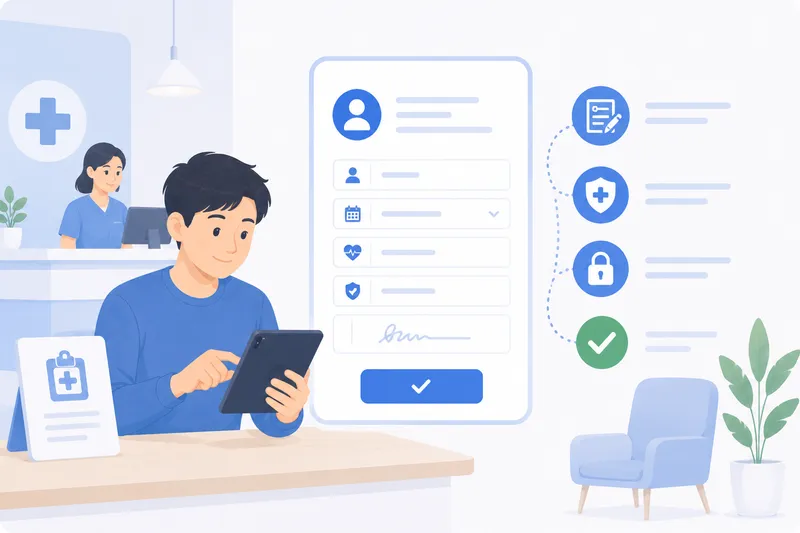
Patient Intake Forms That Save Your Front Desk Hours (Singapore Clinics)
How Singapore clinics and TCM centres can move patient intake online at booking — cutting front-desk workload, queues, and transcription errors, the PDPA-aligned way.
Fewer no-shows. PDPA peace of mind.
See how clinics and TCM practices cut no-shows with automated reminders and keep patient data PDPA-compliant on BooknGo.