
Best Tuition Centre Software Singapore (2026): A Practical Comparison for Tuition and Enrichment Centres
Compare the best tuition centre software in Singapore for 2026 — from WhatsApp and Excel to Edulabs, Tutorbase, and BooknGo — and find the right fit for your centre's size, budget, and local needs.

TL;DR — Most Singapore tuition and enrichment centres still run on WhatsApp and Excel. When that breaks down, the step up is either a purpose-built local platform or a flexible SaaS booking system. This guide covers what each option actually does, where each falls short, and five questions to ask before you commit. The best tuition centre software Singapore centres can rely on handles how you actually charge, communicates through WhatsApp, accepts PayNow natively, tracks student attendance and records accurately, and is built for Singapore term cycles — not adapted from a US or UK product.
Why Tuition Centres Need Different Software
Most booking and scheduling software is built for drop-in businesses — a client books a session, attends, and the credit ticks down. Tuition and enrichment centres in Singapore do not operate this way.
Centres run on school terms. The entire cohort re-enrols at once for ten to twelve weeks. When that window opens, the full administrative load of the centre arrives in 48 hours — hundreds of parent enquiries, payment collection, class assignments, and waitlist management happening simultaneously. Tuition centres typically spend 8–12 hours every week on administrative tasks alone — registering students, tracking attendance, chasing payments, and sending reminders — before a single lesson has been delivered.
The student is a child. The parent is the customer. Every booking confirmation, payment receipt, class reminder, and communication about schedule changes goes to an adult who is not physically at the centre. Families with multiple children across different subjects and levels need their student records maintained as a family unit — not as disconnected individual profiles.
There are also Singapore-specific requirements that make general scheduling software a poor fit. Parents expect PayNow at checkout. Direct communication happens through WhatsApp, not email. Student and parent data must be handled in compliance with the Personal Data Protection Act. School schedules follow Ministry of Education term dates, not calendar months.
Software built for the US or UK market does not deliver any of this by default. The gap between what international tools assume and how Singapore tuition centres actually operate is where most admin breakdowns — and most revenue leakage — happen.
What Singapore Tuition Centres Actually Use
Understanding the current landscape helps centre directors identify where their current setup is likely to break down — and what they are actually comparing when evaluating alternatives.
WhatsApp and Excel
The most common setup across Singapore tuition and enrichment centres, particularly for operations with fewer than 80 active students.
Booking enquiries come in on WhatsApp. The admin confirms manually, adds the student to a spreadsheet, and sends a PayNow number. Reminders go out by hand before each class, or not at all. Attendance is tracked on paper. Term fees arrive via bank transfer with a screenshot as confirmation. Student records — progress notes, makeup credits, payment history — are scattered across spreadsheets, WhatsApp threads, and physical registers.
This setup works at low volume. It begins to break down at 50 to 80 students and becomes genuinely unsustainable beyond that. Every booking requires a human. Every reminder requires a human. Every payment requires manual reconciliation. There is no deposit mechanism for trial classes, no automated waitlist, and no centralised audit trail for student data.
It is also not PDPA-compliant. Student records stored in WhatsApp threads and shared spreadsheets do not meet the requirements for consent capture, secure storage, or role-based access controls. This is a compliance risk most centre directors have not formally assessed.
Edulabs
Edulabs is the most established purpose-built tuition centre management system for Singapore. Developed after consulting with more than 400 local education centres, it is a comprehensive management system covering scheduling, student profiles, attendance tracking, automated invoicing, parent communication, progress reports, and multi-location management from one platform.
Edulabs has native PayNow integration and WhatsApp automation, and is eligible for the Enterprise Development Grant (EDG) and SkillsFuture Enterprise Credit (SFEC) — which can cover up to 95% of project cost for qualifying centres.
The platform’s strength is depth. Centres with complex academic structures — tracking student progress against curriculum benchmarks, managing teaching resources, or generating detailed progress reports for parents — can configure Edulabs extensively for those workflows. It also handles automated billing, payroll reporting, and accounting software integration via Xero or QuickBooks.
The tradeoff is setup complexity and cost. Edulabs uses a project-based delivery model with a one-time setup fee plus a monthly subscription of around S$300. Onboarding takes longer than a standard SaaS rollout. For centres that primarily need booking, parent communication, and payment — rather than a full tuition centre management system with academic and LMS features — the full Edulabs stack may be more than required.
Tutorbase
Tutorbase is a newer Singapore-focused platform for tuition and enrichment centre management. It covers scheduling, billing, PDPA compliance, and PayNow integration, and targets centres looking for a SaaS-style deployment with local support. Still building market presence compared to Edulabs, but worth evaluating as part of a shortlist, particularly for centres earlier in their software journey.
HitPay as a Payment Layer
Some centres use HitPay — a Singapore payment platform — to handle PayNow collection and automated invoicing, layering it on top of WhatsApp bookings and manual scheduling. HitPay solves the payment reconciliation and tracking payments problem but does not address booking management, automated reminders, waitlists, or student records. Centres using this setup typically still run a parallel spreadsheet for everything outside of payment — reducing admin time at one step while leaving the rest of the workflow manual.
International Platforms (iClassPro, Jackrabbit, Teachworks)
International class management platforms are occasionally evaluated by Singapore centres, particularly those researching options through global software review directories. These tools are well-built for their home markets — US and UK tutoring businesses — but carry the same structural gap for Singapore operations: no native PayNow, no WhatsApp automation, no PDPA compliance by default, and billing models that do not map to Singapore school-term cycles. Student attendance tracking and student records management work technically, but the local integrations that make daily operations smooth are absent.
Centres using these platforms typically run separate processes for PayNow collection and WhatsApp communication — adding the admin overhead the platform was supposed to eliminate.
Where BooknGo Sits
BooknGo is a Singapore-built booking and operations platform used by tuition and enrichment centres alongside gyms, spas, wellness studios, and other appointment-based businesses. It is not a full tuition centre management system — there is no LMS, no homework submission, no student progress tracking against curriculum frameworks, and no teaching resources management.
What it covers: online booking with real-time availability, class and term-based enrolment, PayNow native at checkout, automated invoicing, automated WhatsApp and SMS reminders, waitlist management, parent self-service portal, student records and attendance tracking, multi-branch management, and flexible subscription pricing that scales with your centre’s size. The platform has a user-friendly interface designed for both admin staff and parents. EDG and SFEC funding is available for qualifying centres.
The Five Pain Points That Limit Growth
1. Term Re-Enrolment
Term re-enrolment is the highest-pressure administrative moment in the calendar. Hundreds of families registering students simultaneously. Classes filling and the waitlist not updating in real time. Manual management turns what should be a two-hour process into two days of admin — with errors that create follow-up work throughout the term.
Centres that manage this well use online booking with real-time capacity management. When a class fills, it closes automatically. The next family on the waitlist is notified instantly when a spot opens. No manual steps, no risk of double bookings, no parent calling to ask why they could not complete their enrolment.
2. Student Attendance Tracking
Manual attendance tracking — paper registers, spreadsheet updates, or memory — creates errors that compound over a term. Session credits do not deduct correctly. Student records show balances that do not match admin records. Parents query their child’s attendance history and the admin team has to cross-reference multiple sources to answer.
Automated attendance tracking removes this entirely. Tutors mark attendance with one tap per student. The session credit deducts automatically. Real-time attendance data is visible to admin staff and parents through the portal — reducing inbound queries and improving record-keeping accuracy across the centre. Attendance patterns over time also surface insights: which classes have high absence rates, which students are at risk of dropping off, where schedule adjustments could improve engagement.
3. Trial Class No-Shows
A parent books a trial slot and does not appear. No deposit was taken, so there is no financial consequence for them. The centre is left with an empty seat that could have introduced a new enrolled student. For centres running multiple trial slots per week, no-shows represent a meaningful conversion shortfall across the term.
Two changes fix this. Collecting a deposit or full trial fee via PayNow at the point of booking creates a financial commitment. An automated WhatsApp reminder sent 24 hours before the trial gives parents who genuinely cannot attend enough notice to cancel, freeing the slot for the next family on the waitlist. Automated payment reminders combined with deposit collection reduce no-show rates significantly and consistently.
4. Parent Communication Volume
Every term generates booking confirmations, payment receipts, class reminders, makeup class notifications, and package expiry alerts. Managed manually, this is several hours of direct communication per week across the admin team — time that earns nothing and is prone to being skipped when the team is stretched. Centralised communication platforms improve transparency and parental involvement, but they only work if the communication actually goes out consistently.
WhatsApp open rates in Singapore consistently exceed 90%. Automated notifications sent through WhatsApp reach parents through the channel they actually use, at the moment the message is most relevant, without manual intervention. Automated communication platforms also maintain a full log of every message sent — so the admin team is not trying to remember whether a specific family received a particular reminder.
5. Multi-Tutor Scheduling Conflicts
Centres sharing tutors across subjects or locations face a scheduling problem that spreadsheets cannot reliably prevent: the same tutor assigned to two classes simultaneously, or across locations with insufficient travel time. Every conflict creates a scramble to rearrange — and damages parent confidence when it affects a scheduled class. Centralised timetabling with per-tutor availability management and automatic conflict detection eliminates double-bookings at the scheduling step, before they become a problem on the day.
What to Look For: Features That Matter for Singapore Tuition Centres
Student records and data security
A tuition centre management system handles sensitive data — children’s personal details, attendance histories, academic notes, and payment records. The platform must store student data securely with encryption, capture consent at every booking, and apply role-based access controls that restrict who sees what. Admin staff see scheduling and payment data. Tutors see their own class lists and student notes. Parents access only their own children’s information. This is what PDPA compliance requires — and it should be the default, not a configuration task. Security of student data is non-negotiable for any Singapore centre handling records of minors.
Automated invoicing and payment processing
Automated billing and automated invoicing eliminate the manual work of generating invoices, tracking payments, and reconciling bank transfers against student records. Every transaction should generate an invoice automatically. Outstanding fees should surface in the admin dashboard without manual checking. Tracking payments and automated reconciliation save several hours per week for most centres processing more than 50 enrolments per term. For centres with GST registration, the system should generate GST-ready invoices for every transaction.
Attendance tracking and student progress visibility
Attendance tracking should be digital and automatic — updated at each session, deducting session credits in real time, and visible to parents through a self-service portal. Real-time attendance data helps identify student attendance patterns and flag students who are missing sessions before a parent calls to ask why. For centres that provide progress reports to parents, the attendance record forms the factual backbone of that reporting. Note that student progress tracking in the sense of academic performance assessment — grades, assignments, curriculum benchmarks — is a separate function covered by dedicated academic management systems rather than booking platforms.
Parent communication tools
Automated communication platforms that send WhatsApp reminders, booking confirmations, payment receipts, and package expiry alerts are the highest-leverage communication feature for Singapore tuition centres. The best software makes automated notifications standard across all key touchpoints — not a premium add-on. Centralised communication hubs that log every message sent, across all communication channels, give admin teams the visibility to know what parents have been told and when.
User-friendly interface for admin and parents
A user-friendly interface matters for two distinct audiences. Admin staff need to manage multiple classes, student records, and payments efficiently — ideally with key actions accessible in three clicks or fewer. Parents need a mobile-friendly booking and portal experience that does not require a support call to navigate. The best tuition management systems are designed with both users in mind, because a system that admin staff find difficult to use gets bypassed, and a parent portal that parents find confusing does not reduce the inbound query volume it was supposed to eliminate.
Reporting and data-driven decision making
Real-time reporting gives centre directors visibility into class fill rates, revenue by branch, attendance trends, and waitlist demand — the key metrics that inform term-by-term decisions. Data-driven decision making requires that the data is accurate, accessible, and presented clearly. Centres that have moved from spreadsheets to a management system consistently report that the reporting dashboard changes how they plan — because the data that was previously too time-consuming to compile is now available in one view.
Platform Comparison: Singapore Tuition Centre Software
| Feature | WhatsApp + Excel | Edulabs | Tutorbase | BooknGo |
|---|---|---|---|---|
| Online booking 24/7 | No | Yes | Yes | Yes |
| PayNow native | Manual | Yes | Yes | Yes |
| WhatsApp reminders | Manual | Yes | Yes | Yes |
| Automated invoicing | No | Yes | Yes | Yes |
| Term-based enrolment | Manual | Yes | Yes | Yes |
| Attendance tracking | Paper/sheet | Yes | Yes | Yes |
| Student records management | Spreadsheet | Yes | Yes | Yes |
| Parent portal | No | Yes | Yes | Yes |
| Progress reports / academic tracking | No | Yes | No | No |
| Makeup class tracking | Manual | Yes | Limited | Yes |
| Waitlist management | Manual | Yes | Yes | Yes |
| Multi-location management | No | Yes | Yes | Yes |
| Accounting software integration | No | Xero / QuickBooks | Check | No |
| PDPA compliance | No | Yes | Yes | Yes |
| EDG / SFEC eligible | N/A | Yes | Check | Yes |
| Setup model | None | Project + custom | SaaS | SaaS |
| Pricing model | Free | Setup fee + ~S$300/mo | Subscription | Flexible by scale |
Note: Feature availability for Tutorbase reflects publicly available information as of June 2026. Verify current features and pricing directly with each provider before making a purchasing decision.
EDG Grant — What It Covers and Who Qualifies
The Enterprise Development Grant (EDG), administered by Enterprise Singapore, supports Singapore SMEs investing in technology to improve business operations. Software platforms that help tuition and enrichment centres digitise class management, student records, billing, and parent communication are eligible activities under the EDG’s Core Capabilities category.
The grant covers up to 50% of qualifying costs for most applicants. The SkillsFuture Enterprise Credit (SFEC) can provide a further one-off S$10,000 credit covering up to 90% of out-of-pocket expenses on qualifying costs — with some centres achieving combined funding of up to 90–95% of project cost.
Basic eligibility requirements
- Business registered and operating in Singapore
- Minimum 30% local shareholding
- Annual group turnover below S$100 million, or fewer than 200 employees
- Software to be used for Singapore business operations
Both Edulabs and BooknGo are platforms for which qualifying Singapore centres have successfully applied for EDG funding. The application process requires documentation of the business case, cost quotes, and a project plan — typically managed with support from the software provider.
BooknGo has supported EDG applications for Singapore tuition and enrichment centres. One application has been approved; a second is currently in progress. Speak to the BooknGo team about whether your centre qualifies and what the application process involves.
Five Questions to Ask Before You Decide
1. Does it handle how you actually charge?
If you charge by the term, the platform must support term-based plans with defined start and end dates, session balance tracking, and automated expiry reminders. If you also sell prepaid class packages or take pay-per-lesson drop-ins, those should all be manageable from the same system. Automated billing for all fee models — without manual invoice generation — is what separates a real management system from a basic booking tool.
2. Is PayNow built into the booking flow — not bolted on?
PayNow should generate directly at the point of booking, not require a separate payment link sent manually after. Native payment processing at the moment of booking converts parents who are ready to commit. A workaround adds friction at exactly the wrong moment and leaves payment reconciliation partially manual.
3. How does it handle student records and data security?
Student records — attendance history, package balances, payment records, and any notes from tutors — should be centralised in one system with proper access controls. Ask specifically: who can see what? How is consent captured? Where is the data stored, and what security standards apply? For Singapore centres handling children’s data, PDPA compliance is a legal requirement, not a nice-to-have.
4. Does it send WhatsApp reminders automatically?
Automated WhatsApp reminders should be standard, not a premium add-on. The full sequence that matters: booking confirmation immediately, reminder before class, attendance notification after class, expiry alert when a package is running low, and renewal message before term ends. If any of these require manual action, the platform has not solved the daily operations problem.
5. Do you need academic tracking — or just operations?
This is the most important question for narrowing the shortlist. If your centre needs student progress tracking against curriculum benchmarks, detailed progress reports for parents, teaching resources management, or LMS features for online course delivery — you need a dedicated tuition centre management system like Edulabs. If your primary need is booking, payment, parent communication, and attendance — a SaaS booking platform like BooknGo covers the operational layer without the complexity and cost of a full academic management system.
Where BooknGo Sits
BooknGo is built and supported in Singapore. The platform is designed for booking-driven service businesses — tuition and enrichment centres, gyms, wellness studios, and appointment-based operations — where the core need is getting parents booked, paid, and reminded without manual admin intervention across daily operations.
It is not a full academic management system. Centres that need student progress tracking, curriculum-linked reporting, or LMS tools for teaching should evaluate Edulabs, which covers that ground more deeply.
For centres whose primary pain is admin overload, trial class no-shows, re-enrolment drop-off, and the time consumed by manual communication — BooknGo is built to fix exactly those problems. The platform scales from solo tutors on a flexible entry subscription to multi-branch enrichment groups with EDG-funded deployments.
See BooknGo in action — request a demo for your tuition or enrichment centre. Request a demo →
Frequently asked questions
What is tuition centre software and why do Singapore centres need it?
Tuition centre software is a management system that handles class scheduling, online booking, payment collection, parent communication, attendance tracking, and student records in one platform. For Singapore enrichment centres — especially those with multiple branches or more than 50 active students — it replaces manual processes like WhatsApp bookings and spreadsheets with an automated system that reduces admin workload and improves the experience for parents.
What is the difference between a tuition centre management system and a booking platform?
A tuition centre management system typically includes the full range of administrative and academic features: scheduling, billing, attendance tracking, student records, progress reports, teaching resources, and often an LMS for online course delivery. A booking platform focuses on the operational layer: online booking, payment, reminders, and parent communication. Both categories can be EDG-eligible. The right choice depends on whether your centre needs academic tracking features alongside operational management, or primarily needs the booking and communication workflow to be automated.
Is Edulabs or BooknGo better for a Singapore tuition centre?
They serve different primary needs. Edulabs is a comprehensive tuition centre management system with student progress tracking, progress reports, and deep customisation — better suited for centres that need academic management features and are willing to go through a longer setup process. BooknGo is a SaaS booking and operations platform — better suited for centres whose primary need is booking, parent communication, and payment, with faster onboarding and flexible pricing by scale. Both are EDG-eligible and both have native PayNow and WhatsApp.
Can tuition centre software be funded through government grants?
Yes. Singapore SMEs can apply for the Enterprise Development Grant (EDG) through Enterprise Singapore to offset the cost of qualifying business management software. Combined with the SkillsFuture Enterprise Credit (SFEC), eligible centres can receive significant funding support. BooknGo has supported EDG applications for Singapore education centres, with approvals already in progress.
How does the software improve student attendance tracking?
Automated attendance tracking replaces paper registers and manual spreadsheet updates with a digital record that updates at each session. Session credits deduct automatically at attendance confirmation. Real-time attendance data is visible to admin staff through the dashboard and to parents through the self-service portal. Automated alerts notify administrators of frequent absences — giving the centre team the visibility to follow up before a family drifts away entirely.
Does the software work for solo tutors as well as large enrichment centres?
Yes. BooknGo's flexible subscription model scales from individual tutors managing their own client bookings to multi-branch enrichment groups running hundreds of classes per term. Solo tutors use the platform to automate their entire booking and payment flow — eliminating the admin time spent on WhatsApp confirmations, manual reminders, and payment chasing — while larger centres use the multi-location and team management features.
Related articles
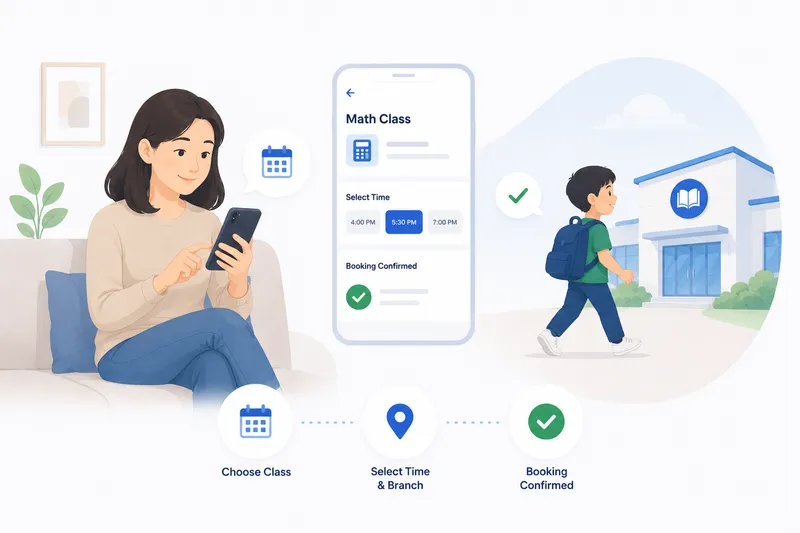
Tuition Centre Booking System Singapore: How BooknGo Runs Your Enrolment, Parents, and Classes
How BooknGo runs your Singapore tuition or enrichment centre — term enrolment, PayNow, automated WhatsApp reminders, attendance tracking, multi-branch management, and EDG grant support.

How to Choose the Best Appointment Scheduler Software for Schools in Singapore
Choosing a school appointment scheduler Singapore? Learn what features matter most, from facility booking to automation and integrations.
Fewer no-shows. Fuller classes.
See how tuition and enrichment centres run trial sign-ups, term schedules, and fee collection on BooknGo.