
Online Booking vs Phone & DM Bookings: The Real Cost
An honest look at taking bookings by phone, DM and walk-in versus a self-service online page — the hidden costs, where each wins, and how they fit together.
TL;DR
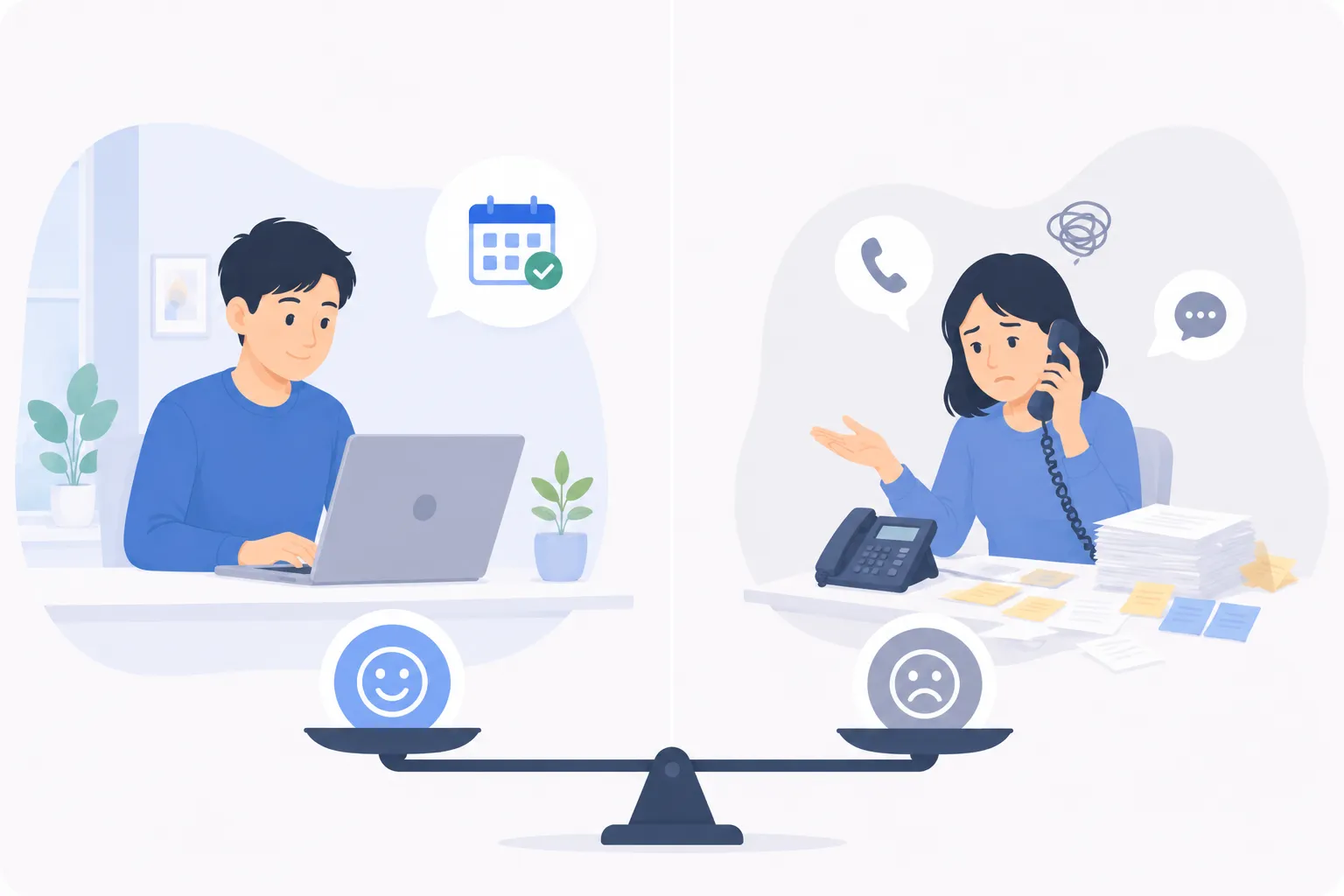
Taking bookings by phone, DM and walk-in feels free, but it carries real hidden costs: calls missed during sessions, after-hours enquiries that go cold, endless message back-and-forth, double-bookings, no-shows and a record trail that lives in your head. A self-service online booking page captures requests around the clock, confirms instantly, can take a deposit and sends reminders automatically. The honest answer is not “online replaces the phone” — it is that online should carry the routine volume so your human attention goes where it genuinely matters. This article weighs both fairly, with a side-by-side table, and shows where the phone still earns its keep.
The bookings you take by phone feel free. They are not.
If you run an appointment-based business, you have probably told yourself that taking bookings by phone, DM and walk-in costs nothing. There is no software fee. No setup. You just answer when someone reaches out.
The problem is that “free” is measured on the wrong axis. The cost of manual booking is rarely a line on an invoice — it is leaked time, lost enquiries and quiet revenue that never arrives. Because none of it is itemised, it is easy to ignore for years.
Let us be fair to the old way first. A phone call is warm. A regular who messages you on WhatsApp gets a human reply. A walk-in gets eye contact. Those things matter, and any honest comparison has to start by admitting it. But the question is not whether the phone has value. It is whether the phone should be your only way to book — and whether the routine, predictable bookings really need a person at all.
The hidden costs of phone, DM and walk-in bookings
Here is where the manual approach quietly bleeds.
Calls missed during sessions
When you are mid-session — teaching a class, treating a patient, cutting hair — you cannot answer the phone. So the call goes unanswered, and a fair share of those callers do not leave a message or try again. They simply book with whoever picked up. You never find out, because a missed call is invisible. There is no record of the booking you didn’t get.
After-hours enquiries that go cold
A large share of booking intent happens outside working hours — evenings, weekends, the moment someone remembers they need an appointment. If your only channel is a phone that no one is staffing, that intent has nowhere to go. By morning, it has cooled. People rarely chase a business twice.
The message back-and-forth that never closes
DM bookings sound efficient until you count the messages. “Do you have Saturday?” “Morning or afternoon?” “What time in the morning?” “Actually, can we do Sunday?” Each booking becomes a thread that you have to hold open in your head and return to between other tasks. Multiply that across a busy week and the admin is relentless — and a meaningful number of threads simply trail off, unbooked.
Double-bookings
When availability lives in one person’s memory or a paper diary, two people can be promised the same slot. Someone arrives to find their time taken. It is awkward, it costs goodwill, and it usually costs you the appointment.
No-shows
A booking taken verbally has no automatic reminder attached and often no deposit. The customer means well and then forgets. Without a system holding their contact details, no reminder goes out unless someone remembers to send one by hand — which, on a busy day, nobody does.
Admin time you will never bill for
Every manual booking is minutes of someone’s day: answering, checking the diary, writing it down, confirming, rescheduling. It is invisible labour that crowds out the actual work and, in small teams, falls on the owner.
No record trail
Perhaps the quietest cost of all. When bookings live across call notes, chat apps and memory, you cannot answer simple questions: Who booked what, and when? Did we confirm? What did we agree on the price? There is no clean history to look back on, no reliable data to plan from, and a shaky footing if a customer disputes what was arranged.
What a self-service online booking page does differently
An online booking system is, at its simplest, a page where a customer sees your real availability and books themselves — no call, no thread, no waiting for you to be free.
That single change fixes most of the leaks above at once:
- It captures requests around the clock. The page is open when you are asleep, in a session, or off for the weekend. After-hours intent gets a place to land.
- It confirms instantly. The customer gets a confirmation the moment they book, and the slot is locked — no double-bookings, because availability is the single source of truth.
- It can take payment at the point of booking. A deposit or full payment at booking gives the customer a reason to show up or cancel in time, and brings revenue forward instead of chasing it after.
- It sends reminders on its own. Because the system already holds the customer’s details, automated reminders go out by WhatsApp, SMS or email without anyone remembering. Fewer forgotten appointments, fewer empty slots. (If no-shows are your main pain, our deeper guide on reducing no-shows and last-minute cancellations goes further.)
- It keeps a clean record. Every booking is time-stamped and stored consistently — who, what, when, and what was paid — so you can plan from real data and stand on firm ground if anything is ever queried.
None of this requires you to stop being human. It just means the routine bookings stop demanding your attention one message at a time.
Side by side: the real cost of each
A fair comparison, not a sales pitch:
| Factor | Phone / DM / walk-in | Self-service online booking |
|---|---|---|
| Availability to book | Only when someone is free to respond | Around the clock, including after hours |
| Missed enquiries | Missed calls and cold DMs vanish unrecorded | Requests land on the page and wait |
| Confirmation | Manual, sometimes forgotten | Instant and automatic |
| Double-bookings | Easy when the diary lives in one head | Prevented — availability is the source of truth |
| Reminders | Only if someone remembers to send one | Automated by WhatsApp, SMS or email |
| Deposits / payment | Awkward to ask for verbally | Collected at the point of booking |
| No-show rate | Higher — no reminder, no commitment | Lower — reminders plus a deposit |
| Admin time per booking | High — answering, checking, writing, confirming | Low — the customer does the entry |
| Record trail | Scattered across notes, chats and memory | One consistent, time-stamped history |
| Personal touch | Strong — warm, human, flexible | Neutral by default; frees you for the moments that matter |
| Best for | Complex, sensitive or first-time enquiries | Routine, repeat and predictable bookings |
The pattern is clear. Online wins decisively on cost, consistency and capture. Manual wins on warmth and on handling the unusual. Those are not in conflict — they describe two different jobs.
Where the phone still earns its keep
It would be dishonest to pretend online booking covers everything. It does not, and you should keep the phone for the cases where it genuinely shines:
- First-time and high-stakes enquiries. A nervous new patient, a wedding party, a bespoke service — these want reassurance and a conversation, not a form.
- Complex or custom requests. Anything that needs back-and-forth to scope is faster as a quick call than as a rigid set of fields.
- Customers who simply prefer it. Some people will always want to speak to a person. Forcing them online to save yourself effort is a poor trade.
- Judgement calls. Squeezing in a loyal regular, waiving a fee, reading a tone — these need a human, and they build the relationships that keep people coming back.
The right model is not “online instead of the phone.” It is online as the default for routine bookings, with the phone reserved for the conversations that deserve one. Keep your number visible. A bookable link should reduce your call volume, not hide you from your customers.
How online and human bookings work together
In practice, the two reinforce each other. The online page absorbs the predictable volume — the repeat appointments, the standard services, the after-hours requests — so your phone rings less, and when it does ring, you actually have the headspace to answer well.
A typical clinic might point most patients to its booking page for routine appointments, freeing the front desk to spend real time with the walk-in who is anxious and unsure. A small studio might let regulars rebook their usual class in two taps, while keeping DMs open for the newcomer who wants to ask about levels first. The machine handles the routine; the human handles the nuance. That is the whole point.
And because everything booked online lands in one place — with consent captured and details held in line with data-protection principles — the record problem solves itself. You stop reconstructing your week from memory and start running it from data.
The honest conclusion
Phone, DM and walk-in bookings are not wrong. They are just expensive in ways that never appear on a bill — missed calls, cold enquiries, endless threads, double-bookings, no-shows and a history that lives in your head. A self-service online booking page does not erase the human touch; it removes the admin so your human touch lands where it counts.
If you are weighing the two, you do not actually have to choose. Put the routine online, keep the phone for the moments that need it, and let each do what it does best.
Stop paying the hidden cost of manual bookings — see how online and human bookings work together in BooknGo. Request a demo →
Frequently asked questions
Is online booking better than taking bookings by phone?
For routine bookings, yes — an online page captures requests around the clock, confirms instantly and keeps a clean record without anyone lifting a phone. Phone still wins for complex, sensitive or first-time enquiries that need a real conversation. Most businesses do best running both, with online handling the routine volume.
Will online booking lose the personal touch my customers value?
It does not have to. Online booking removes the admin friction — the back-and-forth, the chasing, the double-bookings — so your time goes to the moments that actually need a human. You can still take calls and DMs; you are simply no longer the only way to book.
What hidden costs come with phone, DM and walk-in bookings?
The obvious cost is staff time, but the hidden ones add up: calls missed during sessions, after-hours enquiries that go cold, message threads that never close, double-bookings, no-shows from forgotten appointments, and no reliable record of what was agreed. None of these show up on an invoice, which is exactly why they get ignored.
How does online booking reduce no-shows compared with phone bookings?
An online booking captures the customer's contact details automatically, so automated reminders can go out by WhatsApp, SMS or email without anyone remembering to send them. You can also ask for a deposit or full payment at the time of booking, which gives the customer a reason to turn up or cancel in good time.
Do I still need a phone number if I offer online booking?
Yes — keep it visible. A bookable link does not replace being reachable. Some customers prefer to call, some have questions only a person can answer, and some situations are too nuanced for a form. Online booking should reduce your call volume, not pretend the phone has stopped mattering.
Does taking bookings online help with data protection and record-keeping?
It helps. Bookings made through a proper system create a consistent, time-stamped record instead of details scattered across call notes, chat threads and memory. A system aligned with data-protection principles lets you capture consent, hold only what you need, and retrieve or correct a customer's details when asked.
Related articles
Client Data Protection: A Booking Checklist for Service Businesses
A practical, jurisdiction-neutral data-protection checklist for any service business that takes bookings and holds client contact and payment details.
Moving Your Bookings Online: A Step-by-Step Guide for Service Businesses
A practical, vendor-neutral walkthrough for moving a service business from phone, DM and manual bookings to online self-service — step by step, low-risk.
The State of Online Booking in 2026
How consumers and service businesses book in 2026: self-service, mobile-first, messaging reminders, pay-at-booking, and owning your own page.
Ready to fill every slot?
See how BooknGo keeps your calendar full and your admin on autopilot.