
Wellness Centre Booking System Singapore
Singapore wellness centres lose bookings to WhatsApp chaos and no-shows. Here's how PayNow deposits, WhatsApp reminders, and PDPA-compliant scheduling fix it.
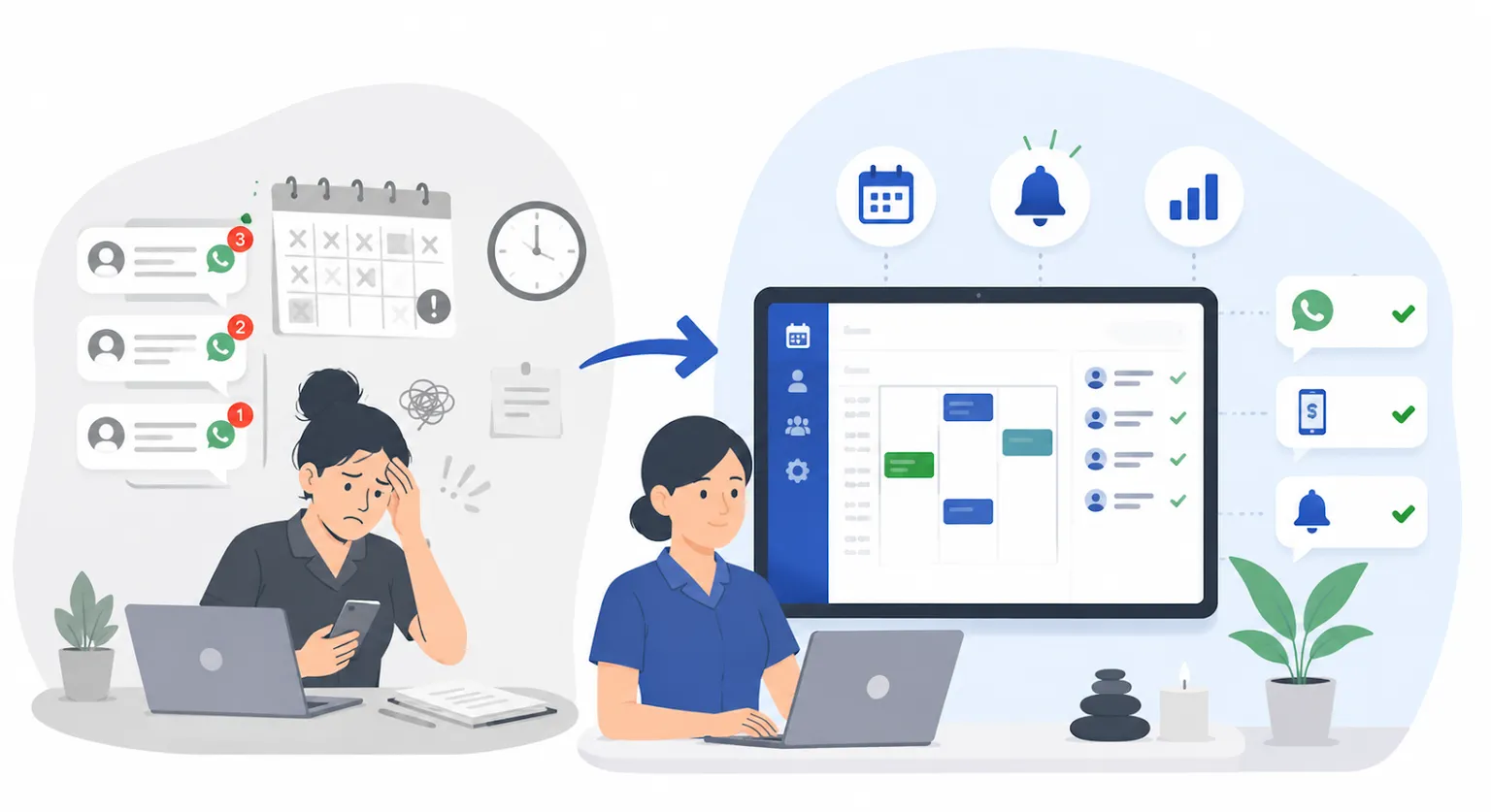
The complete guide for spas, holistic therapy, counselling, and wellness studios (2026).
TL;DR
The best wellness centre booking system for Singapore lets clients book appointments online 24/7, collects a PayNow deposit at booking to secure the session, sends automated WhatsApp reminders, and handles PDPA-compliant client data by default. BooknGo is built in Singapore for wellness businesses — covering spas, counselling centres, holistic therapy practices, TCM, sound healing, sports recovery, and multi-therapist wellness centres — with no marketplace, no commission, and no technical setup required.
The Singapore wellness industry in 2026
Singapore’s wellness sector has grown steadily over the past three years, and the direction of that growth is clear. Traditional spa chains and hotel wellness facilities are no longer the primary destination for wellness services. Boutique wellness businesses — independent practitioners and small studios offering sound healing, holistic therapy, counselling, TCM, sports recovery, and specialist wellness treatments — are drawing clients away from larger, more generic providers because of what they offer: personalised treatment, practitioner relationships, and a quality of experience that a corporate setting cannot replicate.
A shift toward boutique and specialist wellness
The fastest-growing segments of Singapore’s wellness market are also the most specialised. Sound bath studios, pranic healing practitioners, breathwork facilitators, sports massage therapists, and integrative counselling centres are attracting a client base that is health-conscious, digitally fluent, and accustomed to booking premium services on their phone. Yoga studios are expanding their offering into sound healing and restorative therapies. Physiotherapy-adjacent practitioners are positioning themselves within the broader wellness ecosystem rather than as purely clinical services. The boundary between wellness and preventative healthcare is blurring, and boutique providers are at the centre of that shift.
It is worth noting that Singapore’s public healthcare system — polyclinics, restructured hospitals, and facilities such as the Wellness Centre @ NUH — manages patient appointments through national platforms like the HealthHub App. Independent wellness centres and private practitioners operate outside this framework and need their own dedicated appointment booking software to manage their client schedules, collect payments, and handle client data in compliance with PDPA. The right appointment scheduling software bridges this gap: it gives independent wellness businesses the same standard of appointment management as larger healthcare providers, designed specifically for the way boutique wellness businesses operate.
This growth comes with a new set of operational demands. A wellness practitioner running eight to twelve appointments a day, managing deposits and cancellation policies across a mix of regular clients and new bookings, cannot sustain that operation on WhatsApp messages and a spreadsheet. The practices that are growing most consistently are the ones that have moved their appointment management online — allowing them to focus on client care rather than administration.
How Singapore clients book wellness appointments today
The booking behaviour of Singapore wellness clients reflects a market that is mobile-first and accustomed to instant confirmation. A client discovers a practitioner through Instagram, taps a link in the bio, selects a service and available time slot, pays a deposit via PayNow using their mobile device, and receives an automatic confirmation within seconds via WhatsApp — all without a phone call or back-and-forth message thread. This flow works on any web browser, on any device, at any hour. This is the standard that premium wellness clients in Singapore now expect, and practices that cannot meet it lose bookings to those that can.
WhatsApp open rates in Singapore consistently exceed 90%, compared to under 30% for email. For wellness appointments — where a missed reminder translates directly into a no-show and an empty treatment room — the communication channel matters as much as the reminder itself. Practices relying on email reminders are communicating through a channel that a significant proportion of their clients will not see before their appointment time.
The revenue challenges unique to wellness businesses
Wellness businesses face a specific revenue challenge that fitness studios and gyms do not: the cost of a missed appointment is proportionally higher. A yoga class with one empty spot still runs. A massage room with an empty hour is unrecoverable revenue — the therapist is present, the room is ready, and the time passes with nothing to show for it. No-show rates for wellness appointments without deposit requirements are consistently high. At that rate, a practice running forty appointments a week can lose several hours of revenue weekly to clients who simply do not appear.
The solution is well understood: a deposit at the point of booking creates financial commitment, and automated reminders give clients who genuinely cannot attend enough notice to cancel in time for the slot to be filled. The challenge is that implementing both consistently requires a booking system — doing it manually adds hours of admin and still fails to capture every case. The question for wellness business owners is not whether digital appointment management is worth it, but which appointment booking software is built for the way Singapore wellness businesses actually operate — covering everything from appointment scheduling and deposit collection to client management and PDPA compliance.
What Singapore wellness business owners are actually dealing with
The operational friction across wellness businesses in Singapore — spas, counselling centres, holistic therapy practices, sports recovery studios, TCM clinics — follows a consistent pattern. The treatments differ, but the underlying problems are almost always the same.
The WhatsApp booking cycle
Most wellness enquiries in Singapore begin on WhatsApp or Instagram DMs. A client messages asking about availability for a 90-minute deep tissue session. You check your calendar, suggest a time, they respond the next day with a different preference, you confirm, they ask about pricing, you respond, they say they’ll confirm later. Twenty minutes later, a different client messages with the same question. By Friday evening, you have spent three hours this week managing booking conversations instead of treating clients.
Every appointment that goes through WhatsApp is an appointment that requires your active involvement. For a practitioner running a full schedule, this adds up to six to ten hours of admin per week — time that an online booking system eliminates entirely, because clients self-serve from a booking page without any involvement from you.
No deposit means no real commitment
A client who has not paid anything to hold their appointment has no practical reason to notify you if they change their mind. A last-minute cancellation at 10pm the night before means you arrive the next morning with a gap in your schedule that you cannot fill. An empty treatment room costs the same whether the client gave you two days’ notice or none.
Collecting a deposit at the point of booking changes the dynamic fundamentally. A client who has paid $30 to hold a $120 massage session is significantly more likely to attend, and significantly more likely to give you advance notice if they genuinely cannot make it — because they want their deposit back, which means going through the cancellation process rather than simply not showing up. Collecting deposits manually is inconsistent and awkward; doing it automatically at the point of booking is frictionless for both parties.
PDPA compliance as a daily operational risk
Wellness businesses collect sensitive personal information as a matter of course: names, contact details, health conditions, injury histories, and — for counselling and therapy practices — session content and mental health histories. The Personal Data Protection Act requires that this data be collected with explicit consent, stored securely, and accessed only by relevant staff.
Most wellness practices that manage client data through WhatsApp conversations, email threads, and shared spreadsheets are not PDPA-compliant, even if they believe they are. There is no consent capture mechanism in a WhatsApp conversation. There is no access control on a shared Google Sheet. A PDPA complaint from a former client — or a data breach involving a spreadsheet stored on a personal device — exposes the business to regulatory action. For counselling centres and therapy practices handling mental health histories, this risk is especially significant.
Scheduling complexity across multiple therapists
A wellness centre with two or more practitioners faces a scheduling problem that a single diary cannot solve. Each therapist has different availability. Some services require specific rooms or equipment. A client who prefers a particular therapist needs to see that therapist’s availability, not the general schedule. When bookings arrive through multiple channels — WhatsApp, phone, walk-in — double bookings happen. Scheduling conflicts become a daily occurrence. Therapists arrive to find their appointments have changed without notification. The centre owner spends the morning resolving double bookings instead of seeing clients — and has no complete control over what is actually happening across the full schedule.
BooknGo handles online booking, PayNow deposits, WhatsApp reminders, and PDPA-compliant client data for Singapore wellness businesses. Request a demo →
How a wellness centre booking system solves these problems
A wellness centre booking system — also called appointment scheduling software or appointment booking software — moves your entire schedule and client management online. Wellness businesses that move to purpose-built booking software consistently report significant reductions in weekly administrative time, allowing wellness businesses to focus more on client care and less on manual scheduling tasks. The table below shows what changes operationally when a practice moves from manual booking to booking software.
| Area | Manual Booking | Booking Software |
|---|---|---|
| Booking | WhatsApp or phone call | Online 24/7, any device |
| Deposits | Collected manually — often skipped | Captured at point of booking via PayNow |
| No-shows | High without deposit or reminders | Reduced significantly with deposits + reminders |
| Reminders | Sent manually per client | Automated WhatsApp + SMS + email |
| Cancellations | Informal, often last-minute | Policy enforced automatically at booking |
| Scheduling | Spreadsheet or paper diary | Real-time, multi-therapist, conflict-free |
| Client data | WhatsApp, notes, spreadsheets | Centralised, PDPA-compliant, role-controlled |
| Admin time | Several hours/week | Significantly reduced |
| After-hours bookings | Missed until next morning | Captured automatically, 24/7 |
| Payment records | Manual reconciliation | Automatic GST-compliant receipts per transaction |
24/7 online appointment booking
Clients access your booking page — from your website, Instagram bio, or a link shared in your WhatsApp group — and book their own appointments without any involvement from you. No app download required. No account creation friction. Any web browser, any mobile device. Real-time availability is displayed automatically — clients see only open time slots and can book in under two minutes. Offering 24/7 online booking significantly improves customer satisfaction: clients get the flexibility to schedule appointments at their convenience, including at peak hours on weekday evenings and weekends when most wellness bookings actually happen. A practice that only accepts new bookings during working hours loses a significant share of potential appointments to practices that have online booking enabled.
Deposit collection that actually prevents no-shows
Clients pay a deposit or the full session fee via PayNow at the point of booking. The deposit is held against the appointment and the cancellation policy is communicated clearly before the booking is confirmed — so there are no disputes and no difficult conversations. Clients who cancel within the configured window forfeit their deposit or part of it, depending on the policy you set. The financial commitment of a paid deposit is the single most effective tool for reducing no-show rates; combined with automated reminders, wellness practices typically see no-show rates drop by 30% or more.
Automated WhatsApp, SMS, and email reminders
The moment an appointment is booked, automatic confirmations go to the client via WhatsApp, SMS, and email. Reminders follow at intervals you configure — 48 hours before the session and 2 hours before are the most effective sequence for wellness appointments. Automated SMS and email reminders meaningfully reduce no-show rates on their own; combined with deposit collection, the impact is significantly greater. Clients who genuinely cannot attend respond to the 48-hour reminder, giving you enough notice to offer the slot to someone on your waitlist. Google Calendar and Outlook can sync directly with booking confirmations so clients always have their appointment times in their personal calendar. For recurring bookings — a client attending weekly counselling or fortnightly sports recovery — the confirmation and reminder sequence runs automatically for every session without any manual effort.
PDPA-compliant client data by default
Client intake information, health declarations, digital waivers, and session visit history are collected through the booking system with explicit consent captured at every booking. Access to client records uses role-based access control — a front desk staff member sees what they need to manage the schedule; a practitioner sees their own client records; the centre owner has full visibility. Data is stored securely in the cloud with SSL encryption, not in WhatsApp conversations or shared spreadsheets on personal devices. Secure online payments processed through PayNow and credit card are handled within the same PDPA-compliant environment. For counselling centres and therapy practices handling sensitive personal information, compliance with PDPA — and by extension the principles of GDPR — is built into every interaction, not something that requires separate configuration.
Multi-therapist scheduling without conflicts
Each practitioner in a multi-therapist wellness centre manages their own availability. Clients can select a preferred therapist or be matched to the next available practitioner automatically. The system prevents double bookings across all channels — regardless of whether the booking came through the online page, an Instagram link, or a direct referral. The centre owner watches the full schedule from a single dashboard: which therapists are fully booked, which rooms are in use, and where capacity is available.
Session packages and client retention
Multi-session packages — a block of six sports recovery sessions, a ten-session counselling package, a monthly wellness membership — are tracked automatically with balances visible to clients at the point of rebooking. Clients can also set up recurring bookings for regular appointments, with automatic confirmations for each scheduled session. When a package is running low, an automated message via WhatsApp prompts renewal before the client drops off. A client’s full visit history — sessions attended, packages used, booking preferences — is visible in their profile, giving practitioners context before each appointment and giving the business owner a clear picture of client engagement across the full client base.
Want to see deposit collection, PDPA-compliant intake forms, and multi-therapist scheduling in action? Request a demo →
Booking systems for different types of wellness businesses
Singapore’s wellness sector covers a wide range of business models — from yoga studios and wellness clubs offering group classes to solo holistic practitioners and multi-therapist counselling centres. The scheduling requirements of a day spa differ significantly from a counselling practice, which differ again from a sound healing studio or a multi-service wellness centre. A good appointment booking system adapts to each format rather than forcing every business into the same structure.
| Business Type | Key Booking Requirements |
|---|---|
| Day Spas & Massage Centres | Multi-service + duration scheduling, therapist matching, room management, deposit at booking, customisable cancellation policy |
| Counselling & Therapy Practices | Fixed-duration sessions, recurring weekly/fortnightly bookings, PDPA-compliant intake forms, role-controlled access to client records |
| Sound Healing, Reiki & Holistic Therapy | Solo practitioner booking page, group session capacity management, instant deposit collection, automated waitlist for popular sessions |
| Sports Recovery & Active Wellness | Same-day booking, recurring sessions, package deals (e.g. 6-session block), repeat client scheduling around training schedules |
| Multi-Therapist Wellness Centres | Per-therapist availability, centralised owner dashboard, multi-service pricing, multi-location support, staff scheduling |
| TCM, Nutrition & Specialist Consultations | Fixed consultation slots, intake questionnaire at booking, client history tracking, session notes, package management |
Why wellness businesses are moving away from marketplace platforms
Many Singapore wellness businesses initially built their client base through aggregator platforms — services that list multiple practitioners and let users browse and book across them. These platforms offer genuine exposure for new businesses trying to reach clients who do not yet know them. But as businesses grow, the economics and strategic implications of marketplace platforms become increasingly problematic.
Your clients see competing practitioners every time they book
When a client opens an aggregator app to book a session with your spa or therapy practice, they are simultaneously shown every other spa or therapist in their area — listed by price, availability, and rating. Your business is competing for attention on your own booking confirmation screen. The platform’s interest is in keeping users on the platform and maximising bookings across all listed providers, not in building loyalty to any individual practitioner. Every booking made through an aggregator is a booking that could have gone to a competing practice instead.
Direct booking removes this entirely. A client who books through your wellness centre’s own page sees only your services, your practitioners, and your pricing. There are no competing listings, no alternative suggestions, and no platform incentives pulling them toward other providers.
You do not own the client relationship
On marketplace platforms, the client relationship belongs to the platform. Contact details are controlled by the platform. Communication goes through the platform. When a client stops using the platform, they may stop booking with you — even if they valued your service — simply because the habit of opening that app is gone. Wellness businesses that build their client base through direct booking own the relationship entirely: contact details, booking history, treatment preferences, and the communication channel. This is especially important for counselling and therapy practices, where the practitioner-client relationship is the foundation of the work.
Commission compounds quickly at wellness price points
A typical wellness marketplace platform charges a new client fee on the first booking of each client who discovers your business through their platform. Payment processing fees apply on top of this for all bookings. For an active practice acquiring new clients regularly, these fees accumulate quickly — and that cost continues for as long as the practice depends on the marketplace for client acquisition. A practice that builds its client base through direct booking pays neither the new client fee nor the dependency that comes with it.
BooknGo charges a flat monthly subscription. There is no commission on appointments, no deduction from PayNow deposits, and no per-booking charge on packages. What your clients pay goes directly to your practice, with predictable monthly costs that are easy to manage as your business grows.
Brand ownership and long-term client loyalty
Clients who book directly with your wellness practice — through your branded booking page, with your name, your services, your practitioner profiles — are building a relationship with your brand. Clients who book through an aggregator are building a relationship with the aggregator. Direct booking consistently produces higher retention rates, higher package renewal rates, and higher client lifetime value than aggregator-sourced clients — because the loyalty is to the practitioner, not the platform.
Why BooknGo
Most appointment booking software available in Singapore was built for Western markets or for fitness classes rather than appointment-based wellness practices. The product functions technically — but the assumptions built into it do not reflect how Singapore wellness businesses operate, how Singapore clients prefer to pay, or what PDPA compliance actually requires.
Built in Singapore, for Singapore wellness businesses
BooknGo is built and supported in Singapore. PayNow is native — not an add-on. WhatsApp reminders are built in. PDPA consent capture, secure cloud storage, and role-controlled access to client records are standard features, not premium upgrades. GST-compliant receipts are generated automatically for every transaction. For counselling and therapy practices handling sensitive client data, PDPA compliance is embedded into every booking flow — not something you configure separately or explain to a foreign support team.
No marketplace. No commission.
BooknGo is not a marketplace. Your booking page shows your services, your practitioners, and your pricing — nothing else. There are no competing listings, no alternative suggestions, and no platform incentives redirecting your clients to other providers. BooknGo charges a flat subscription with no commission, no per-booking fees, and no hidden charges on PayNow transactions. What your clients pay stays in your practice.
One platform for the full operation
BooknGo delivers a full suite of powerful features for service-based businesses: online appointment booking, real-time availability management, PayNow deposit collection, customisable cancellation policies and booking rules, automated waitlists, WhatsApp and SMS reminders, staff scheduling, PDPA-compliant client intake forms and digital waivers, session package and membership management, visit history and client management, multi-location management, and GST-compliant payment records — all from one dashboard. You have complete control over your schedule, your client data, and your revenue, without patching together separate tools for each function. Wellness business owners consistently report reclaiming significant admin time after moving to an online booking system — time that goes back into client care.
How much does wellness booking software cost?
Pricing for appointment booking software varies widely. Entry-level tools start at $0 per month with limited features, while full-featured platforms for wellness businesses with multiple therapists and locations typically range from $50 to $300 or more per month. Some platforms also charge commission on transactions or per-booking fees — costs that add up quickly at wellness price points. BooknGo charges a flat monthly subscription with no commission and no per-booking fees. For studios evaluating options, Capterra’s Singapore wellness software directory provides pricing comparisons and reviews from local business owners.
Frequently asked questions
What is the best booking system for wellness centres in Singapore?
The best wellness centre booking system for Singapore allows clients to book appointments online 24/7, collects a PayNow deposit to secure the session, sends automated WhatsApp and SMS reminders, handles PDPA-compliant client intake forms, and supports multi-therapist scheduling — all without requiring technical setup. BooknGo is built specifically for Singapore wellness businesses and covers all of these requirements out of the box.
How does a booking system reduce no-shows at a wellness centre?
Two tools work together: deposit collection at booking creates financial commitment, and automated WhatsApp reminders give clients who cannot attend enough notice to cancel in time for you to fill the slot. Clients who have paid a deposit are significantly less likely to no-show, and significantly more likely to notify you in advance when they genuinely cannot make it. Wellness practices using both typically see no-show rates drop by 30% or more.
Does my wellness centre need to be PDPA-compliant?
Yes. Any wellness business in Singapore that collects client names, contact details, or health information must comply with the Personal Data Protection Act. This requires explicit consent at the point of data collection, secure storage of records, and controlled access. For counselling centres and therapy practices handling session content and mental health histories, compliance is especially important. BooknGo captures consent at every booking and stores client data securely with role-controlled access — PDPA compliance is built in by default.
Can I manage bookings for a wellness centre with multiple therapists?
Yes. BooknGo supports multi-therapist scheduling — each practitioner manages their own availability, clients can select a preferred therapist, and the system prevents double bookings across all channels. The centre owner sees the full schedule from one dashboard. For multi-location wellness businesses, each location's schedule is managed from the same platform.
Is a booking system worth it for a solo wellness practitioner?
Especially so. Solo practitioners bear the full cost of manual booking management — every WhatsApp conversation, every reminder sent, every deposit chased is time taken away from client care. An online booking system handles all of this automatically. Many solo practitioners report saving five or more hours per week, and a measurable increase in confirmed bookings simply because clients can book at any hour — including when the practitioner is mid-session and unable to respond.
Can I collect deposits and enforce cancellation policies automatically?
Yes. BooknGo lets you set a deposit amount per service and configure your cancellation policy — the window within which a client can cancel and receive a refund, and the conditions under which the deposit is forfeited. The policy is displayed to clients before they confirm their booking, so there are no disputes. Enforcement is automatic — you do not need to chase clients or have difficult conversations about last-minute cancellations.
Related articles

How to Choose the Best Appointment Scheduler Software for Salons in Singapore
Discover how beauty salon appointment software in Singapore can transform your salon’s booking flow, protect your time, and elevate the client experience.
Keep every chair booked.
See how salons, spas, and wellness studios take 24/7 bookings, deposits, and reminders on BooknGo.